


Grant Burge Meshach Shiraz 2022
Style: Red Wine
Variety: Shiraz
Closure: Screwcap
Grant Burge Meshach Shiraz 2022
Warehouse
34 Redland Drive
Vermont VIC 3133
Australia
Critic Score: 97
Alcohol: 14.5%
Size: 750 ml
Drink by: 2050
Meshach Shiraz, first released in 1988, is the flagship of the Grant Burge winery that deservedly fits in the Outstanding category of Langton's Classification of Australian Wine. Fruit is sourced primarily from the Filsell Vineyard near Lyndoch which was planted in 1920, but also includes contributions from three small sites with vines over 100 years old. The wine is matured in new and old French oak for around 18 months. Meshach, named after Grant Burge's great-grandfather, is a classic, rich Barossa Shiraz prized for its cellaring potential.
"The star of the Burge range and very much one of the Barossa’s iconic Shiraz, even better when it comes from such a fine vintage as 2022. This sits amongst the better releases of Meshach and is a wine in great form. Black with an opaque purple rim, the wine is beautifully fragrant, exceptionally well balanced and offering great energy. There is remarkable balance and immense length here with intensity maintained throughout, through to the silkiest of tannins. A complete wine. If one suggests that this wine could last twenty to thirty years without a problem, that does not mean it can’t be enjoyed well before then. Stunning stuff." Ken Gargett
"Deep dark crimson with incredibly dark hues. On the nose, red and black cherry lift with lashings of blackberry and hints of blueberry. Overtones of darker mocha and dried nutmeg, cinnamon and clove. Bright lush fruit entry with multi layers of fruit, mostly red to black cherry with spice. Bright blackberry with layers of spice and chocolate. The exquisite tannins are dark, reminiscent of dark chocolate, with a huge dense core and fruit sweetness. The texture is fine but firm in its direction and finish is long and lush with a hint of espresso to complete. A hugely dense palate with boldness in flavour the wine is big but well balanced in its entirety." Grant Burge
Expert reviews
97 points - Ken Gargett, Wine Pilot
"The star of the Burge range and very much one of the Barossa’s iconic Shiraz, even better when it comes from such a fine vintage as 2022. This sits amongst the better releases of Meshach and is a wine in great form. Black with an opaque purple rim, the wine is beautifully fragrant, exceptionally well balanced and offering great energy. We have notes of black fruits, bay leaves, florals, licorice, cassis, coffee beans and spice market notes. There is remarkable balance and immense length here with intensity maintained throughout, through to the silkiest of tannins. A complete wine. If one suggests that this wine could last twenty to thirty years without a problem, that does not mean it can’t be enjoyed well before then. Stunning stuff. Drink: 2026-2056."
96 points - Dave Brookes, Halliday Wine Companion
"A wine with a strong cellaring pedigree, the Meshach is looking very good indeed with the '22 release. To my eyes, there's a little more elegance rather than solid horsepower in recent years and I like that very much. Blackberry, boysenberry and red cherry fruits with hints of baking spices, clove, mocha oak, blueberry pie, violets, dark chocolate and olive tapenade. Graceful and fruit pure on the palate with fine, chocolatey tannins, impressive density and balance and a sustained finish with vibrant plum skin acidity. Drink by 2045."
96 points - Gabrielle Poy, The Real Review
"Raspberry licorice, red plums and rose petal mix with sweet spices and coffee grounds on the nose. Subtle tertiary notes are emerging: forest floor and iodine that temper the ripe fruits and florals. It's incredibly tense yet the palate remains bouyant and fresh, setting it up for great longevity. The tannins are firm and fine, almost silty, providing the foundations for aging. In its youth it's still quite embryonic and inward, though it hints towards greatness. This is a premium Barossa shiraz that combines old school flavour with a modern freshness. Drink: 2027–2035."
96 points - Ray Jordan, Wine Pilot
"The ’22 vintage has certainly resulted in some exceptional wines from the Barossa and this is another wonderful example of what was produced in that year. The color is a deep inky black with subtly light red. The aroma is a sort of a dark mix of fruitcake, dark plum, blackberry with lifted spice and a touch of creamy mocha. The palate has a firm spine, but there’s a suppleness about it as well with the delicious ripe fruit in abundance. In many ways, it bridges the old-style Barossa with the new, with the emphasis on the new. So it is impeccably poised and balanced and ready for a lengthy stay in the cellar. But make no mistake, you can drink it now. Drink: 2026-2051."
96 points - Andrew Calliard MW
"Deep crimson. Liquorice, dark cherry, blackberry marzipan aromas. Generously concentrated and velvety textured with pure blackberry, praline flavours, plentiful graphite/chocolaty tannins, and attractive mocha, roasted almond notes. A classical Barossa Shiraz with the volume, richness and torque for long-term ageing. 14.5% alc. Drink 2026–2045."
Awards
Gold Medal - Melbourne Royal Wine Awards 2025
Gold Medal - Barossa Wine Show 2025
Gold Medal - Decanter World Wine Awards 2024
Gold Medal - Barossa Wine Show 2024
About the winery

The Burge name and the Barossa Valley share a history that goes back to the 1800s, but it was fifth generation winemaker Grant Burge who was instrumental in taking his brand to the world.
The family's story began in 1855 when John Burge, his wife Eliza, and sons Meshach and Henry arrived in Lyndoch from England. In 1865, Meshach installed fermenting tanks in one of his sheds, intending to create wines that he could share with his friends and family. Out of his generosity came what is today the Grant Burge brand.
Meshach’s son Percival established a winery just outside Lyndoch in the Depression. "Third generation Percy Burge couldn’t sell his grapes during the Depression in 1928 and decided to make wine," says Grant. "It was all fortified wines in those days."
Percy’s son Colin married Nancy Arthur and Grant was born. Grant has fond childhood memories of the winery his father and uncle, Noel, took over back in the fifties. "I grew up in that environment, my playpen was the winery and I loved it and always knew I wanted to be a winemaker."
When Grant left school, Nancy saw that the wine market was steering away from fortifieds to table wines and would not allow her only son to join the family business. "I won’t tell you what I thought of her at the time! But, she was absolutely correct and that forced me to go out and do my own thing."
Owning his own wine brand was Grant’s vision right from the start and in the late 1970s and early 1980s, he teamed up with Ian Wilson, another 'young turk' of the industry, to begin Burge and Wilson in McLaren Vale.
"In those days, there was no winery other than the one I worked at that could make white wine, so we had to come to the Barossa to make it," Grant explains. "I played cricket with Rod Chapman down in Lyndoch and he was the manager at Krondorf winery. He said come up and make your wine there, so we did. After two years, in 1977, he said boys, bad news, Dalgety is going to sell the winery. But it’s good news for you guys, you should organise someone to buy it. The day it came on the market, we put in our offer and on my birthday, 20th January, 1978 we took the keys. I was 27 and my business partner was 25. That in itself created a lot of publicity… How the hell could these two youngsters go and buy a winery?"
The Krondorf, Burge and Wilson brands became household names winning big trophies in all states, including the sought-after Jimmy Watson Trophy. "In 1979 we won a heap of trophies around Australia for our wine and then in 1980 we won the Jimmy Watson after Wolf Blass won his Jimmy Watsons and had really made it something… He was the competition, but we admired him – he was the king."
"Honestly, I’ve never been a rock star but that year all the interviews and the rest of it – it was like you were Rod Stewart!" laughs Grant. "That win really launched the brand. I remember the first year we sold 11,000 cases, the next year we sold 22,000, the next was 44,000, then 88,000 and after eight years we were nearly up to 200,000 cases of wine. In 1983 we went public and we raised $8 million to fund that growth, it was just amazing."
Grant had already met the love of his life, Helen whom he married in 1981. Life and business were blossoming and eventually Mildara came knocking to buy out Krondorf Wines’ shareholders. "Helen and I wanted to buy the company… but the share price had gone so high that we couldn’t afford it." They sold their shares and Grant began to buy vineyards around the southern villages of Williamstown and Lyndoch, including the Krondorf vineyards. "We really went out and bought a lot of vineyards… interesting because vineyards were losing money at the time."
Grant worked as production director for Mildara for two years and on weekends, managed his own vineyards. In 1988, Grant established Grant Burge Wines and purchased Wine keller, a restaurant, which he turned into a cellar door and office. He was going to build a winery at the site to crush grapes, but the late Doug Lehmann, who was winemaker at Basedow’s in Tanunda at the time, offered an alternative. "Doug rang and said Grant, come and make your wine here… I’ve got plenty of capacity and I’ll give you a good deal. If your winery succeeds, you can always build yours later and if it doesn’t, you won’t need one. I said that’s very good logic!"
In 1993, Grant bought that very winery and grew the business into an internationally renowned brand producing 750,000 cases per vintage and turning over $70 million. In 2015, Grant sold the business to global company Accolade Wines with his vineyards continuing to supply the brands he created.
Today, the Grant Burge name is carried forward and driven by Chief Winemaker Craig Stansborough who, like Grant, is a Southern Barossa native, having grown up in Gawler. Craig joined Grant in 1993, became Senior Winemaker in 1997 and since that time has helped the business define itself through a set of highly respected wines that primarly celebrate the Southern Barossa.
"The Southern part of the Barossa has always been underrated," Craig explains. "Grant was a Lyndoch boy and he had a bias for this area and since the early days it’s been a big part of our style. The South Burge territory, 80 per cent of what we do comes from that end of the Valley, it’s always been our home and is a big part of our style, probably more than anyone else in the region.
"The south gets more rain than the rest of the valley and we tend to pick earlier. This tends to give good fruit brightness and purity without compromising density and concentration and detail in our wines without the tannin and the riper, sweeter characters that the Barossa is generally known for."
Parts of the above text are taken from an article by Alicia Lüdi-Schutz in The Barossa Mag and an article on Grant Burge in Wine Selectors.
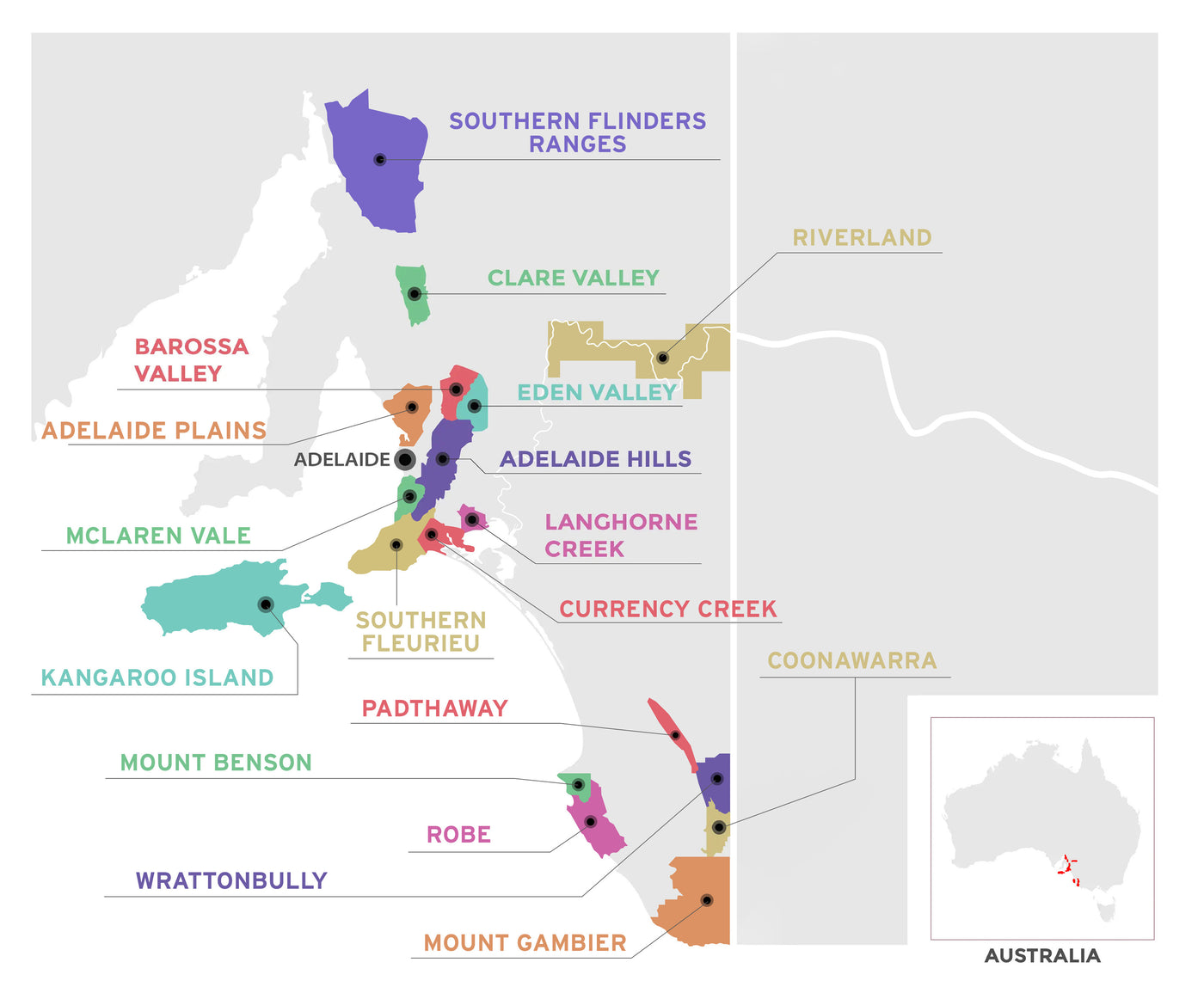
South Australia
South Australian is responsible for more than half the production of all Australian wine. It is home to more than 900 wineries across 18 wine regions. The regions are Adelaide Hills, Adelaide Plains, Barossa Valley, Clare Valley, Coonawarra, Currency Creek, Eden Valley, Kangaroo Island, Langhorne Creek, McLaren Vale, Mount Benson, Mount Gambier, Padthaway, Riverland, Robe, Southern Fleurieu, Southern Flinders Ranges and Wrattonbully.
Many of the well-known names in the South Australian wine industry established their first vineyards in the late 1830s and early 1840s. The first vines in McLaren Vale were planted at Reynella in 1839 and Penfold's established Magill Estate on the outskirts of Adelaide in 1844.
South Australia has a vast diversity in geography and climate which allows the State to be able to produce a range of grape varieties - from cool climate Riesling in the Clare and Eden Vallies to the big, full bodied Shiraz wines of the Barossa Valley and McLaren Vale. Two of Australia's best-known wines, Penfolds Grange and Henschke Hill of Grace, are produced here. There is much to discover in South Australia for the wine lover.