


Holm Oak Arneis 2025
Style: White Wine
Closure: Screwcap
Holm Oak Arneis 2025
Warehouse
34 Redland Drive
Vermont VIC 3133
Australia
Critic Score: 95
Alcohol: 13.0%
Size: 750 ml
Drink by: 2030
Holm Oak is located just north of Launceston, in Tasmania's Tamar Valley. Holm Oak is a labour of love for winemaker Bec Duffy and her viticulturist husband Tim Duffy. Since 2007 they have followed their dream of crafting delicious expressions of cool-climate Tasmanian wines. They specialise in Chardonnay, Pinot Noir and Riesling that reflect the terroir of the pristine Tamar Valley, but also produce a small quantity of delicious Arneis - a white grape variety most commonly thought to have originated in Northern Italy's Piedmont region.
"A wine with captivating interest, this Tassie Arneis from Holm Oak takes me back to my time in Piedmont six months ago. It's an excellent drink. White-fleshed peaches, cut pear, golden apple and fresh apricots make a positive first impression along with almonds and fennel. Some apricot juice wriggles forward with pears and a neat honeysuckle twist. A creamy drive sits at the core with a nutty tempo keeping the rhythm. Beautiful drinking and a wine I'd confidently recommend for those who enjoy a white wine with some complexity. What a beauty!" Steve Leszczynski
"The wine is bright and light straw in colour. The nose is quite generous with floral aromas but also that of caramel, ripe pear, some white stone fruit, melon and a hint of cake batter and honey. This is where the Arneis surprises because, although the florals, pot pourri and honey dew melon flavours are there again, the palate is quite refreshing and supple. This is largely due to the wine’s fresh acidity and silky tannins. Nevertheless, the Arneis has enough texture to add length and balance to the slightly saline/mineral finish. All this makes this a very versatile food wine which would pair very well with seafood or lighter pasta dishes.
The fruit for this wine was harvested when it was showing classic honeysuckle and grapefruit characters. The fruit was pressed and allowed to settle for 18 hours before being transferred to our Numblot egg (25%) and seasoned oak barrels. The wine underwent natural fermentation. Following fermentation, the wine was aged on yeast lees for 5 months prior to bottling." Holm Oak

Winemaker Bec Duffy talks about Arneis
Expert reviews
"A wine with captivating interest, this Tassie Arneis from Holm Oak takes me back to my time in Piedmont six months ago. It's an excellent drink. A step up from the 2024 release, white-fleshed peaches, cut pear, golden apple and fresh apricots make a positive first impression along with almonds and fennel. Some apricot juice wriggles forward with pears and a neat honeysuckle twist. A creamy drive sits at the core with a nutty tempo keeping the rhythm. Beautiful drinking and a wine I'd confidently recommend for those who enjoy a white wine with some complexity. What a beauty!" Steve Leszczynski, Qwine - 95 points
"Holm Oak is the sole producer of arneis in Tasmania but with only 400 vines planted to the variety there's not much to go around. Like the 2024 vintage, this latest release is a revelation. Honeysuckle, pear, stone fruit and apple abound on both the nose and palate, the latter textural and complex and driven by vibrant acidity that refreshes the long finish." Nick Munday, Canterbury Wines - 95 points and Special Value Wine ★
"I wish there was more of this variety grown in Australia, although there’s certainly enough here to please even my palate. It saw time in a non-blot egg and seasoned oak with natural fermentation and then further ageing on yeast lees for about five months. So you have the fairly typical floral, crunchy pear and stone fruit characters, but there is a degree of complex input from the winemaking which has added another dimension. It retains a crunchy, refreshing intensity and acidity and has a lovely, almost sea-spray-like mineral finish. Excellent wine for the shorter term. Drink: 2026-2031." Ray Jordan, Wine Pilot - 94 points
"25% of the wine is transferred to Numblot egg and the rest into seasoned oak barrels. A wine with fleshy golden apples, poached pears and honeysuckle. There is yellow lemon skin and baked cracked sandstone minerals. A touch of meringue and just toasted coconut shows the round curves of oak. The salinity feels more like salted almond milk, creamy but with an edge of brine. There is complexity here but wrapped in a silk sheet of moreish sip-ability. A wine that would work with delicate seafood like clams but also be at home with a cauliflower cheese bake." Shanteh Wale, Wine Pilot - 93 points
Awards
Special Value Wine – Canterbury Wines ★
About the winery
 Holm Oak is located just north of Launceston, in Tasmania's Tamar Valley. Holm Oak is a labour of love for winemaker Bec Duffy and her husband Tim Duffy, viticulturalist. Since 2007 they have followed their dream of crafting delicious expressions of cool-climate Tasmanian wines.
Bec Duffy has over 20 years winemaking experience in Australia and the US, while Tim Duffy, a third-generation grape grower and an agronomist with extensive viticultural experience, manages the vineyard, Their complementary skills drive their vision to produce delicious wines that reflect their home, Tasmania's pristine Tamar Valley, and their own personalities – honest, down to earth, genuine and authentic.
Grape vines were planted in the rich and fertile land in 1983, making Holm Oak one of the older vineyards in Tasmania. Using the original Pinot Noir and Cabernet plantings, they now also cultivate Arneis, Chardonnay, Merlot, Pinot Gris, Riesling and Sauvignon Blanc. In total, Holm Oak has 12 hectares under vine.
Holm Oak is a full family affair overseen by general manager Pinot 'd' Pig. Like any good manager, Pinot the Pig wanders around keeping a close eye on the daily operations in the vineyards and winery. Pinot was supposed to be a miniature pig, however has grown to be a full-size team member, with a larger than life personality, and a keen eye (and nose) for detail. Every good manager however, has a weakness – if fed a couple of fresh apples, the worries of General Management fade away and Pinot is inclined to sleep on the job!

"Holm Oak in Tasmania's Tamar Valley gained its name from a planting of oak trees in the 1930s, intended to provide oak for tennis racquets. It came to nothing, and 50 years later 2ha of cabernet sauvignon and 0.4ha of pinot noir were planted.
In 2004 Ian and Robyn Wilson bought the property with a succession plan in place, their daughter Rebecca (Bec) already an experienced winemaker having worked on the mainland and in California. She arrived at Holm Oak in 2006, and the onsite winery was completed just in time for the 2007 vintage.
In the same year Bec's partner, agronomist Tim Duffy, arrived and they set about expanding the vineyard from 6a to 15ha; in pride of place is 7ha of pinot noir, with MV6 clone leading the census, plus D5V12, 114, 115, 777, D4V2 and 521. In 1991, 1ha of riesling had been planted; the balance now includes pinot gris (2ha), chardonnay (1.5ha) and arneis (0.3ha), with smaller plantings making up the remainder.
Prior to the completion of the winery, the wines had been competently contract-made. It's a very different story today, with shoot thinning, leaf plucking (on the western side) and removal of shoulder bunches of pinot noir (if needed). The partnership between winemaker and viticulturist has had multiple synergies, as success has followed success. Then there's the Southern Ocean, a vast air conditioner buffering the heat spikes that are part of summer in the southeastern corner of the mainland.
Sparkling wine used 37% of the total crush, which left pinot noir with 28%, sauvignon blanc, chardonnay and pinot gris in a three-way share of 8% each, riesling the remainder. One simple summary is sparkling, red and white wine, each with a third share. And Tamar Valley is the place to be, with almost 40% of the 2022 crush." James Halliday
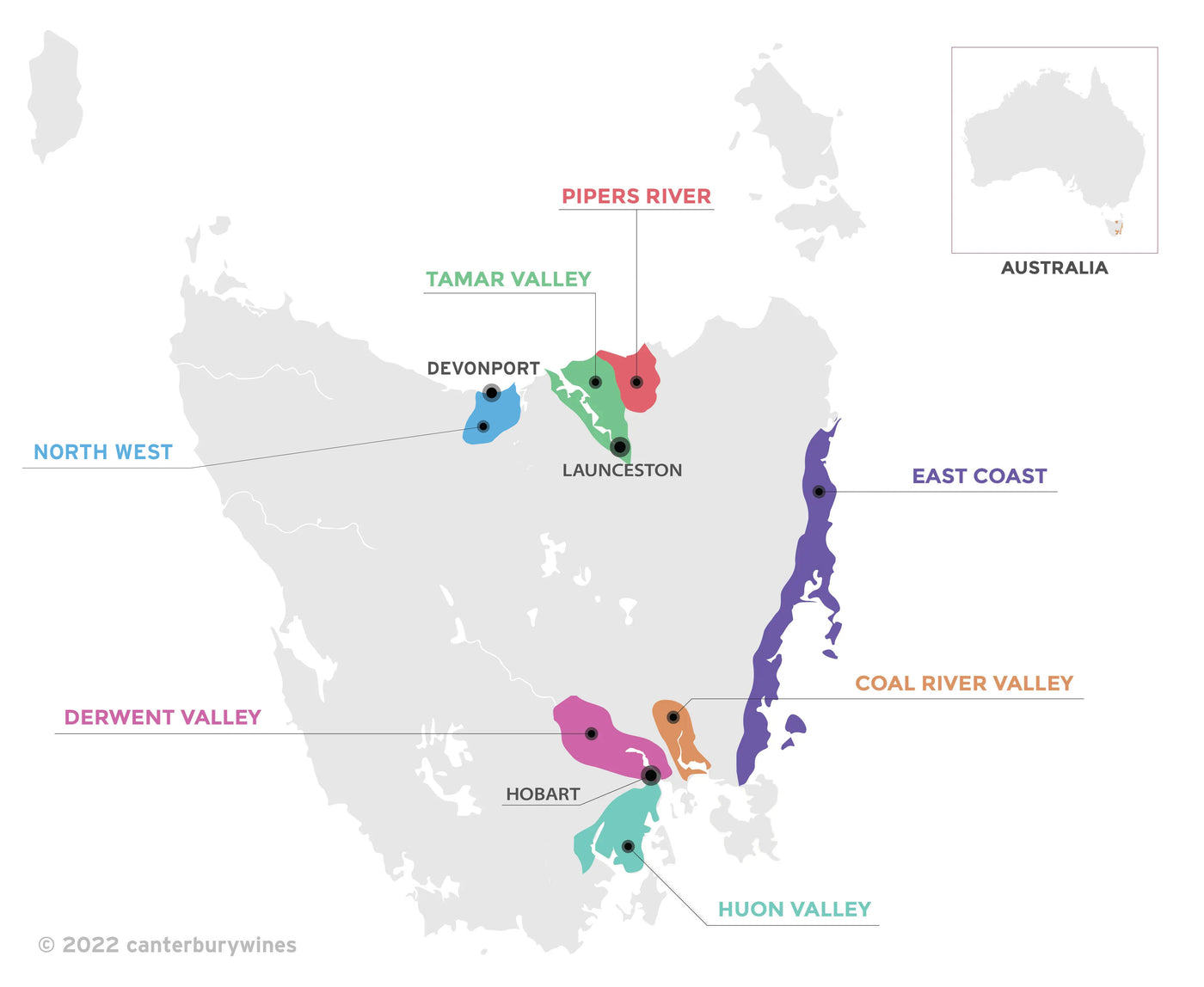
Tasmania
Tasmania is a small island located below mainland Australia. It produces less than 1% of Australia’s wine but enjoys a global reputation as a leading producer of premium cool climate wines. It is prized for its top-class sparkling wine, Pinot Noir, Chardonnay and Riesling.
Tasmania is home to more than 230 wineries across 7 wine regions*. The reigions Coal River Valley, East Coast, Pipers River and Tamar Valley produce around 90% of Tasmania's wine, while the other three regions Derwent Valley, Huon Valley and North West produce the remaining 10%. * Please note these 7 wine areas are considered here to be subregions of Tasmania to aid site navigation.
Tasmania is the coldest wine State in Australia. Its climate is temperate, with a distinct maritime influence from the Tasman Sea to the east, Bass Strait to the north and the Indian Ocean to the west. Summer days are temperate while winter sees some of the coldest temperatures in Australia. It's unique climate and soils combine to create ideal growing conditions for cool-climate grape varieties.