


Holm Oak Chardonnay 2025
Style: White Wine
Closure: Screwcap
Holm Oak Chardonnay 2025
Warehouse
34 Redland Drive
Vermont VIC 3133
Australia
Critic Score: 95
Alcohol: 13.0%
Size: 750 ml
Drink by: 2035
Holm Oak is located just north of Launceston, in Tasmania's Tamar Valley. Holm Oak is a labour of love for winemaker Bec Duffy and her viticulturist husband Tim Duffy, Since 2007 they have followed their dream of crafting delicious expressions of cool-climate Tasmanian wines. Chardonnay, Pinot Noir and Riesling are outstanding.
"Wonderfully styled with elegance and complexity, the wine shows ripe peach, rockmelon, vanilla, oatmeal, and biscotti nuances on the nose. The concentrated palate exhibits refined texture and beautifully pitched acidity, with a persistent and engaging finish." Sam Kim
"This Chardonnay is bright, pale straw in colour and presents a floral bouquet combined with nectarine, white peach and a hint of vanilla spice. The palate is fresh and juicy with a mixture of white peach and honeydew melon. It is soft and slippery at the start and on the mid palate but has satin texture on the finish complimented by refreshing acidity.
The fruit for this wine was picked when the flavour profile was in the citrus/nectarine spectrum. Three clones of Chardonnay from two separate blocks were used to make this wine. The fruit was gently pressed to tank and allowed to settle for 24 hours prior to being racked to barrel (30% new French oak and 70% 1-4 year old). The wine underwent 100% natural fermentation, and 50% malolactic fermentation. The wine was then matured in oak for 8 months with occasional lees stirring to enhance texture and mouthfeel." Holm Oak
Expert reviews
"This is a light, crisp, and quite linear Chardonnay that comes from three separate clones of two blocks. It received 30% new French oak and the remainder in one- to four-year-old oak and underwent all-natural fermentation, with half the wine going through malolactic fermentation. Further oak maturation with some lees stirring has built the texture and complex mouthfeel. It’s lovely floral notes with a spicy vanilla pod and nectarine-like character. It has a beautiful, clean, and crisp palate that finishes with a lovely spicy lift. Drink: 2026-2032." Ray Jordan, Wine Pilot - 95 points
"Wonderfully styled with elegance and complexity, the wine shows ripe peach, rockmelon, vanilla, oatmeal, and biscotti nuances on the nose. The concentrated palate exhibits refined texture and beautifully pitched acidity, with a persistent and engaging finish." Sam Kim, Wine Orbit - 95 points
"Three clones of Chardonnay were racked to 30% new French oak barrels and the remainder in seasoned oak. 50% went through malolactic fermentation and matured with occasional lees stirring. This is already a very giving wine, generous and plush in its peach and cooked nectarine, with lemon curd and Swiss vanilla buttercream. Acidity steers the wine along, maintaining a zippy edge to the fruit power, but fruit as always in this wine speaks with the most confidence. It feels like a miniscule amount of salt has seasoned the wine, appropriately as this is a wine you will want to keep sipping on. Drink now or will cellar well for another 5-8 years. Serve with a celeriac cream and panfried slab of cod. Drink: 2026-2034." Shanteh Wale, Wine Pilot - 94 points
"Light straw with characters of lemon, peach and nectarine, hints of meadow flowers, crème fraîche, citrus zest, shortbread, spiced oatmeal, sea spray and crushed stone. There's a swell of biscuity oak on the palate that meshes nicely with the peach and citrus fruits, an appealing tension and clarity to the interplay between fruit and acidity and a finish that flares and lingers nicely. Drink by 2031." James Halliday, Halliday Wine Companion - 93+ points
"Three clones of Chardonnay were used here, with the fruit coming from two discrete blocks. A natural fermentation in barrel, 30% of that being new French oak, was followed by 50% of the wine undergoing malolactic fermentation. Maturation was for a further eight months with occasional stirring of the lees. A straw hue, the nose reveals notes of nectarines, citrus, spices, hints of oatmeal and lemon curd. There is good intensity throughout with impressive focus and balance. A sleek texture runs right through to the lingering and rather persistent finish. A most attractive style for enjoying over the next six to eight years. Drink: 2026-2034." Ken Gargett, Wine Pilot - 93 points
About the winery
 Holm Oak is located just north of Launceston, in Tasmania's Tamar Valley. Holm Oak is a labour of love for winemaker Bec Duffy and her husband Tim Duffy, viticulturalist. Since 2007 they have followed their dream of crafting delicious expressions of cool-climate Tasmanian wines.
Bec Duffy has over 20 years winemaking experience in Australia and the US, while Tim Duffy, a third-generation grape grower and an agronomist with extensive viticultural experience, manages the vineyard, Their complementary skills drive their vision to produce delicious wines that reflect their home, Tasmania's pristine Tamar Valley, and their own personalities – honest, down to earth, genuine and authentic.
Grape vines were planted in the rich and fertile land in 1983, making Holm Oak one of the older vineyards in Tasmania. Using the original Pinot Noir and Cabernet plantings, they now also cultivate Arneis, Chardonnay, Merlot, Pinot Gris, Riesling and Sauvignon Blanc. In total, Holm Oak has 12 hectares under vine.
Holm Oak is a full family affair overseen by general manager Pinot 'd' Pig. Like any good manager, Pinot the Pig wanders around keeping a close eye on the daily operations in the vineyards and winery. Pinot was supposed to be a miniature pig, however has grown to be a full-size team member, with a larger than life personality, and a keen eye (and nose) for detail. Every good manager however, has a weakness – if fed a couple of fresh apples, the worries of General Management fade away and Pinot is inclined to sleep on the job!

"Holm Oak in Tasmania's Tamar Valley gained its name from a planting of oak trees in the 1930s, intended to provide oak for tennis racquets. It came to nothing, and 50 years later 2ha of cabernet sauvignon and 0.4ha of pinot noir were planted.
In 2004 Ian and Robyn Wilson bought the property with a succession plan in place, their daughter Rebecca (Bec) already an experienced winemaker having worked on the mainland and in California. She arrived at Holm Oak in 2006, and the onsite winery was completed just in time for the 2007 vintage.
In the same year Bec's partner, agronomist Tim Duffy, arrived and they set about expanding the vineyard from 6a to 15ha; in pride of place is 7ha of pinot noir, with MV6 clone leading the census, plus D5V12, 114, 115, 777, D4V2 and 521. In 1991, 1ha of riesling had been planted; the balance now includes pinot gris (2ha), chardonnay (1.5ha) and arneis (0.3ha), with smaller plantings making up the remainder.
Prior to the completion of the winery, the wines had been competently contract-made. It's a very different story today, with shoot thinning, leaf plucking (on the western side) and removal of shoulder bunches of pinot noir (if needed). The partnership between winemaker and viticulturist has had multiple synergies, as success has followed success. Then there's the Southern Ocean, a vast air conditioner buffering the heat spikes that are part of summer in the southeastern corner of the mainland.
Sparkling wine used 37% of the total crush, which left pinot noir with 28%, sauvignon blanc, chardonnay and pinot gris in a three-way share of 8% each, riesling the remainder. One simple summary is sparkling, red and white wine, each with a third share. And Tamar Valley is the place to be, with almost 40% of the 2022 crush." James Halliday
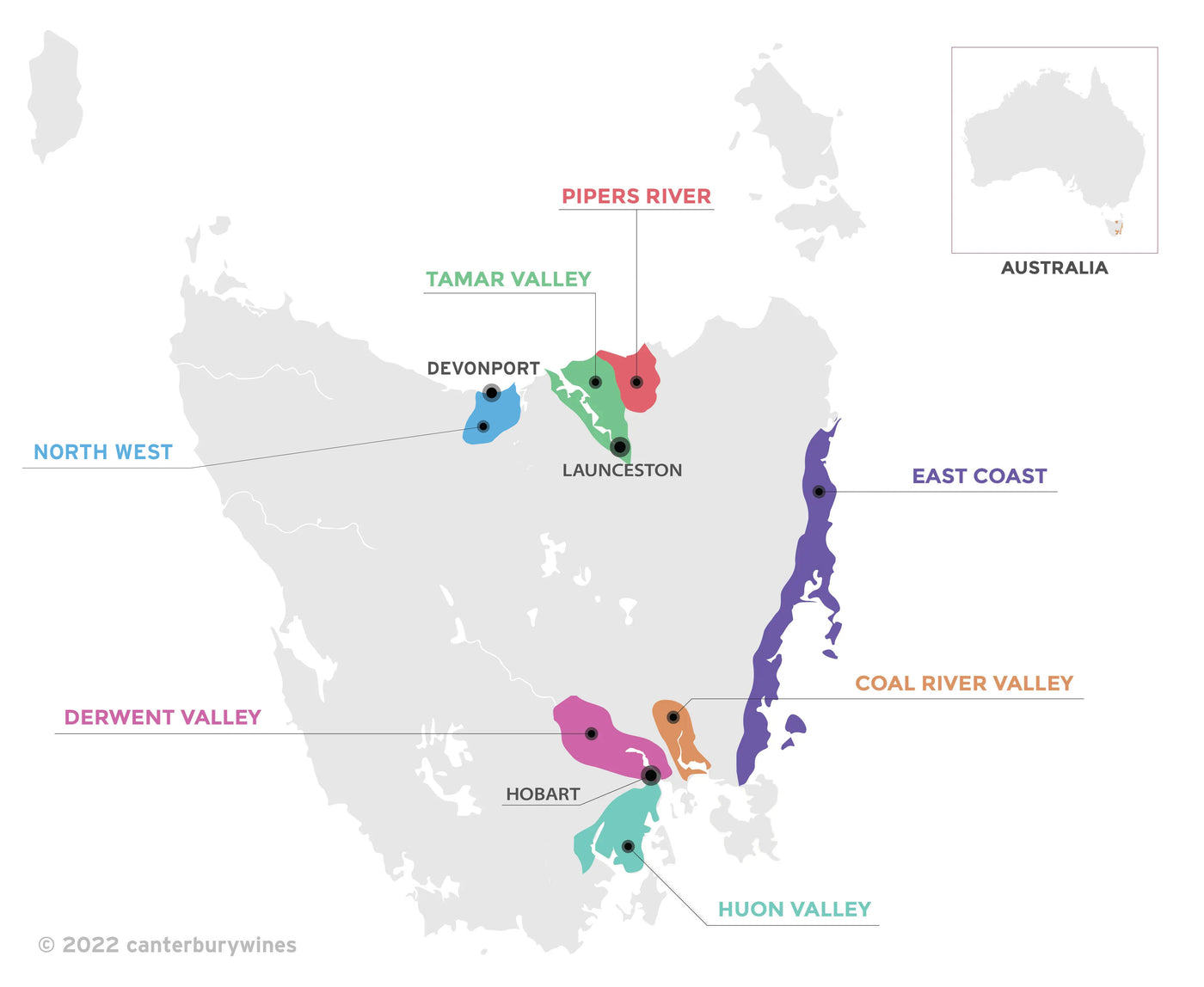
Tasmania
Tasmania is a small island located below mainland Australia. It produces less than 1% of Australia’s wine but enjoys a global reputation as a leading producer of premium cool climate wines. It is prized for its top-class sparkling wine, Pinot Noir, Chardonnay and Riesling.
Tasmania is home to more than 230 wineries across 7 wine regions*. The reigions Coal River Valley, East Coast, Pipers River and Tamar Valley produce around 90% of Tasmania's wine, while the other three regions Derwent Valley, Huon Valley and North West produce the remaining 10%. * Please note these 7 wine areas are considered here to be subregions of Tasmania to aid site navigation.
Tasmania is the coldest wine State in Australia. Its climate is temperate, with a distinct maritime influence from the Tasman Sea to the east, Bass Strait to the north and the Indian Ocean to the west. Summer days are temperate while winter sees some of the coldest temperatures in Australia. It's unique climate and soils combine to create ideal growing conditions for cool-climate grape varieties.