


Penfolds Bin 707 Cabernet Sauvignon 2024 (Gift Box)
Style: Red Wine
Variety: Cabernet Sauvignon
Closure: Cork
Penfolds Bin 707 Cabernet Sauvignon 2024 (Gift Box)
Warehouse
34 Redland Drive
Vermont VIC 3133
Australia
Critic Score: 98 and 19/20
Alcohol: 14.5%
Size: 750 ml
Drink by: 2060
Bin 707 is Penfolds cabernet sauvignon Grange equivalent. The style relies on the riper spectrum of cabernet sauvignon flavours and tannins, is matured in new American oak and expresses the Penfolds policy of multi-vineyard, multi-region fruit sourcing. Named by an ex-Qantas marketing man, Bin 707 was first vintaged in 1964. The wine was not made from 1970 to 1975 (when fruit was directed to other wines) nor in 1981, 1995, 2000, 2003, 2011 or 2017 (when fruit of the required style and quality was not available). Full bodied and with good cellaring potential, Bin 707 has a secure place among the ranks of Australia's finest cabernets.
"Seriously concentrated, glass-staining colour; opaque purple-red; the bouquet is savoury and oak-touched, showing less varietal cabernet signature but more 'great wine character'. There are walnut, fresh earth/humus and broken rock aromas, taking cabernet to a higher level than mere varietal character. As you work the glass, its identity becomes more obvious as the fruit starts to express itself. A supremely dense and concentrated - yet balanced - wine with great power and panache. An outstanding Bin 707." Huon Hooke
"Arguably the best Penfolds red, consistently expressive of exemplary cabernet qualities, Bin 707 is sourced from several South Australian regions, principally the Barossa and Coonawarra. A benchmark cellaring wine, revived in the 1970s after Len Evans told Penfolds their decision to delete it some years earlier bordered on the insane." Jeremy Oliver
The 2024 Penfolds Bin 707 is 100% cabernet sauvignon sourced from premium vineyards in Coonawarra, Barossa Valley and Padthaway. The wine was matured for 16 months in new American oak hogsheads.
"Impenetrable. Dark core. Luminous sheen. The nose is expressive. Very Cabernet! An oscillation between blue and black fruits – from blueberry and mariposa plum to blackcurrant/cassis/aniseed and Star Anise. And yet so much more – black olive, rhubarb and a bevy of savoury/fleshy notes. An aftermath of earlier barrel fermentation has induced a formative aromatic imprint – graphites, whetstone and walnut notes coalesce. Integrated oak is totally absorbed – nuances of sandalwood and cedar ever-so-suggestive? What type of oak? Hard to guess. One word will have to do… stylish. The palate has impressive presence and density yet retains finesse and shape. Poise/power are abetted by a mass of tannin – fine and pixelated, never dominating. The tannin/acid interplay invokes an impression of an Italian derivation. Everywhere. Tannins push and pull, they bind, they convey, they…. Blues and violets attest to variety. Charm and presence confirm Bin 707. Oak? As per above! Difficult to ascertain whether to leap now and enjoy the primaries, or cellar and await the tertiaries. Maybe both? Peak drinking: 2028-2060." Penfolds
Expert reviews
"This is a massive and unnerving Bin 707, and I am getting the same vibes as villagers do in Game of Thrones when the silhouette of a massive dragon passes behind a cloud. It’s not often a wine makes me feel this much on edge. And unlike RWT, which turns Hyde to Jekyll, this wine is malevolent, confrontational and all-powerful. Thank goodness then the nose is intensely Cabernet-soaked and identifiable because the rest of the wine is a leviathan. It’s too much for me, so I will duck out. But lovers of structured, imposing Cabernet will perform cartwheels for this wine. My score reflects its dimensions." Matthew Jukes - 19++/20 points
"Seriously concentrated, glass-staining colour; opaque purple-red; the bouquet is savoury and oak-touched, showing less varietal cabernet signature but more 'great wine character'. There are walnut, fresh earth/humus and broken rock aromas, taking cabernet to a higher level than mere varietal character. As you work the glass, its identity becomes more obvious as the fruit starts to express itself. A supremely dense and concentrated - yet balanced - wine with great power and panache. An outstanding Bin 707. Drink 2030–2049." Huon Hooke, The Real Review - 98 points
"Smoke, graphite, garrigue herbs, class. This is one for the ages. It’s a perfect combination of coolness and warmth, herbs and sweet curranty fruit, integration of vanillin oak and wide, long formations of tannin. Guerilla warfare maybe not, but this wine would win an old school war, it’s so ordered and strong and disciplined and mighty. The best fruit, from a cooler year, in the hands of experts, for the win here. This is a great Bin 707. Drink: 2034 - 2050+." Campbell Mattinson, The Wine Front - 98 points
"The 2024 Bin 707 Cabernet Sauvignon is sourced from Coonawarra, Barossa Valley and Padthaway and raised 100% in new American oak. "If the fruit can't stand up to the new American oak, then it's not destined for 707," says chief winemaker Peter Gago. While the élevage may feel prohibitive in its early days, I can say from lived experience that it protects the fruit from the vagaries of aging, and the old bottles of Bin 707 are fresh, vibrant and lovely, lovely things. I always expected to detest (in some form) the combination of American oak and Cabernet Sauvignon, but for this cuvée, I am glad to make an exception. It's like stridently Penfolds. So here, this 2024 Bin 707 Cabernet Sauvignon is inky, plush, powerful, fresh, detailed and very long. The consistent ripeness from the excellent (warm, dry) vintage in South Australia brings with it a supple pliability, while the tannins are profuse and gritty. This is very good, but it's a baby. Patience is recommended, with the expectation that this cuvée will age 30 or 40 years with ease. Drink: 2026-2054." Erin Larkin, Wine Advocate - 97+ points
"The flagship Cabernet in the Penfolds stable continues to champion the house philosophy of multi-regional blending, marrying the structure of Coonawarra with Barossa Valley depth and Padthaway generosity. Matured exclusively in new American oak, Bin 707 remains one of Australia’s most ageworthy expressions of Cabernet Sauvignon. Deep and commanding from the outset with blackcurrant, cassis, blackberry and dark plum wrapped around black olive, graphite, cedar, tobacco leaf and dark chocolate. The palate is dense and authoritative, layering blackcurrant, blackberry, liquorice, cedar spice and cocoa over a frame of substantial but beautifully ripe tannins. Concentration is exceptional without feeling cumbersome, while bright acidity keeps the wine remarkably energetic through an exceptionally long finish. A commanding release with decades ahead of it. Drink: 2026-2056." Tom Kline, Wine Pilot – 97 points
"The 2024 Bin 707 renders almost opaque in the glass, with its trademark monolithic core of black fruit possessing all the power and inherent cellaring potential that has stamped the wine with such reverence. Densely packed with ripe blackberry, black cherry and blackcurrant fruits with hints of brown spices, crème de cassis, cedar, choc-mint, ironstone, bay leaf, polished leather, black olive tapenade, pan juices, turned earth and coal dust. It's powerful and poised, with a solid plinth of black fruits encased in barrel spice and liminal glimpses of tobacco and leather. The interplay of fruit, tannin and acidity is bang on here, with an impressively long draw of flavour. The palate shape is dense, kinetic and hints at great potential in the cellar. Tremendous stuff. Drink by 2060." Dave Brookes, Halliday Wine Companion - 97 points
"Cabernet from Coonawarra was excellent in 2024 and core to this 707, joined by fruit from the Barossa Valley and Padthaway. A very dark purple/magenta, the nose exhibits aromas of dark plums, cassis, cigar boxes, chocolate, vanilla, spices and dried herbs. Early complexity is most certainly evident. On the palate we move to even more intricate flavours, including blackberries and blueberries, smoked meats, beef stock, tapenade, coffee beans and tobacco leaves. A wine with focus and balance, satiny tannins and serious length, with its intensity maintained throughout. A wonderful 707 for enjoying over the next three decades, during which we can expect that there is every chance the score might edge up just a smidge. Drink: 2026-2056." Ken Gargett, Wine Pilot - 97 points
"Wonderfully balanced and expressive straight on release with seductive aromas of blackberries, blueberries, mint, dark chocolate, walnut, boysenberry, cedar and graphite. The palate is silky with melting tannins and a full, textural mouthfeel, giving a powerful yet restrained, elegant and moreish finish. Aged for 18 months in 100% new American oak hogsheads. An excellent bottling drinking beautifully now but time in the cellar will reap maximum rewards. Drink or hold." Ryan Montgomery, JamesSuckling.com - 97 points
"Bin 707 offers an arresting youthful look at cabernet mixing a range of regional points of difference – Coonawarra, Barossa Valley, Padthaway – in what was a dry, warm vintage. Dense purple. Intense leafy blackberry, cassis aromas with aniseed, sage and bay leaf, cedar, savoury earthy notes and a super spiced intensity. More is revealed on the palate which is super taut and structured in fine savoury tannins with oak taking high notes amid ripe black fruits, chocolate, spice, earth and dried herbs. Not necessarily singing in tune just yet with a fruit presence that is still quietly underplayed. First thoughts? This is simply too young for release. Second and third thoughts? How long should I age it before making an approach? I would give it at least 10 years, those tannins are telling you as much. Drink: 2034-2054." Jeni Port, Wine Pilot – 97 points
"Deep crimson. Dark chocolate, cassis, grilled almond aromas with herb garden notes. Concentrated pure blackcurrant, damson plum, praline flavours, densely compact fine grained/ cedar tannins and well balanced roasted chestnut notes. Leafy/ chocolaty firm at the finish. Still in its elemental phase but very good density and flow. Should develop very well. 16 months in American oak hogsheads. Coonawarra, Barossa Valley, Padthaway. Drink: 2028 -2055." Andrew Caillard MW - 96 points
The story of bin 707

Bin 707 Cabernet Sauvignon, Penfolds first commercial release of a single cabernet-based wine, is linked to Max Schubert's dream of making a great Australian red wine that could last at least 20 years.
When Penfolds purchased the 1888-planted Kalimna Vineyard, including the prized Block 42 plantings of cabernet sauvignon, the varietal was still quite rare in Australia. Schubert had originally thought the Kalimna Vineyard might be a source for Grange, but early crops proved unreliable.
During the '50s and early '60s cabernet sauvignon was mostly used for blending, but Schubert's breakthrough with the varietal as a stand-alone wine came in 1964, at a time when Penfolds was expanding its red table wine portfolio. Early Bin 707 Cabernet Sauvignons were typically open fermented under wax-lined header boards and matured in seasoned old oak (rather than new oak). While these early wines were well received by trade and media, a disappointing 1969 vintage led Penfolds to discontinue production until it could find reliable and consistent fruit.
Penfolds Bin 707 Cabernet Sauvignon returned with the 1976 vintage, primarily based on Coonawarra fruit with vital input from the Barossa Valley. Since then the winemaking blueprint for Bin 707 has been almost identical to Grange, including partial barrel fermentation and 18 months maturation in new American hogsheads. Within a few years of its relaunch, Bin 707 was considered by collectors as a benchmark Australian cabernet sauvignon.
Coonawarra and Barossa Valley, particularly the Kalimna and Koonunga Hill vineyards, have been at the heart of the Bin 707 Cabernet Sauvignon since the 1970s. Today, the cool-climate Robe, Padthaway and Wrattonbully vineyards in South-East South Australia are additional sources.
Winemaking is very similar to Grange, and as a consequence, the style relies on the riper spectrum of cabernet sauvignon flavours and tannins. In colder growing seasons, when it is difficult to reach optimum ripeness, the wine is not released. These strict selection principles ensure continuity of the Bin 707 style and quality across all released vintages.
Penfolds Rewards of Patience 2021
Peter Gago

The following text is taken from an article by Ken Gargett in Quill & Pad, https://quillandpad.com
Peter Gago has what many people in the wine world think is the best job on the planet. He is chief winemaker for Penfolds, based in South Australia and one of Australia’s oldest wine producers.
Max Schubert created Grange with the experimental first wine, the 1951, after he returned from Bordeaux and wanted to establish an Aussie First Growth. The story of Grange has been told many times, and as fascinating as it is I won’t rehash it again. Schubert ruled at Penfolds right through to the 1976 vintage, when he handed the reins to Don Ditter. Ditter made the wines right through to the 1986 vintage when John Duval stepped up. Duval was chief winemaker until the 2002 vintage, when he left to do his own thing, very successfully.
Since that time, Peter Gago has been the chief winemaker. It should be noted that although the role of chief winemaker at Penfolds will always be inextricably linked with Grange, there are a great many other wines in the portfolio for which this position assumes ultimate responsibility.
Alongside the winemaking, in which he is still heavily involved, a usual week in non-Covid times sees Gago flying around the world to tastings, dinners, events, festivals, and promotions. I suspect that only David Attenborough (outside of pilots and crew) has racked up more flying miles. I remember seeing him one day when he seemed even more pleased with the world than usual. Turns out he’d just run into his wife, Gail, now retired but a long-term and highly regarded member of the South Australian parliament, at the airport. Gago had not been aware that they would both be in the same country that week, let alone cross paths, such is his usual peripatetic lifestyle.
Gago has friends and admirers all around the globe, from the rich and famous to young, aspiring wine lovers, and will spend time talking to them all. I suspect that if he wanted to start dropping names, the din would reverberate for days, but you could not find a humbler man. Gago is a serious music buff and you’d be amazed at the number of rock stars who revere him, much in the way their fans might do for them (for instance, after crawling over broken glass to get a ticket to a Bruce Springsteen concert I saw Gago sitting in prime seats with Springsteen’s family, after which they went for dinner and knocked off a few bottles of Grange).
Gago is probably as close to a rock star himself in the world of wine, although perhaps more modest rather than flamboyant. And I have no idea if he can sing.
The thing that most amazes me with Gago is that every time you talk to him, he is bubbling with genuine enthusiasm, not just for Grange but for all his wines. He just loves what he is doing. One gets the feeling that every morning he wakes up and pinches himself to make sure it is real.
Among his many attributes, Gago has the gift of the gab like few others. Only once have I ever seen him lost for words and caught off guard. Many years ago, at the annual release – held in a very fancy location near the shores of Sydney Harbor; it is always a fancy location somewhere and also always includes great champagne to kick off the day as Gago is fanatical about the world’s best bubbles – the then current chairman or CEO of whichever corporate entity was then the owner of Penfolds attended the day. Forgive me for my failure to remember just where the corporate snakes and ladders left Penfolds that day and for failing to remember the relevant gentleman’s name. He had only been appointed as a temporary executive while the search for a more permanent one was ongoing, but unlike any of the CEOs before and after, this man had a genuine interest and came to a couple of tastings to learn.
Anyway, as we sipped our champagne on the lawns overlooking Sydney Harbor and chatted, our friend suddenly posed a question to Gago. He had been meaning to ask, he said, just how much Grange the company made. There were five or six writers in this little group and suddenly, every single one of us had pad and pen poised. The production of Grange is a national secret that is not to be disclosed under pain of death (general consensus puts it at, depending on the vintage, between 5,000 and 15,000 cases, with most releases in the mid range, but this is pure speculation).
Gago was at a loss. The boss of bosses had just asked him a direct question and Gago is far too polite not to answer but knew he couldn’t give that information out in public. He managed a fair bit of mumbling and generalizations and I think he suggested they meet later. Pads and pens all went back into bags, and we could not help grinning while Gago looked like he’d just swallowed a bad oyster.
Gago was born in England in 1957, but his family moved to Melbourne when he was only six years of age. Originally a math teacher (teaching is still a passion), he undertook a science degree at the University of Melbourne and then attended Roseworthy College, a famous Australian winemaking college, graduating as Dux (the highest ranking academic performance -ed), which will surprise no one.
In 1989 he joined Penfolds as a sparkling winemaker, working with Ed Carr, who has established a career in sparkling wine (now with Arras) as successful as Gago’s is with table wines. He moved to reds and quickly rose through the ranks until succeeding Duval in 2002. In the 73 years since Schubert was first appointed, Gago is only the fourth chief winemaker.
During his tenure, he has stacked up an extraordinary array of bling, as has Penfolds under his stewardship (Gago heads a team of eight winemakers for table wines and a couple more for fortifieds). He has several “Winemaker of the Year” awards from different entities and publications, both from Australia and abroad, but the accolades go well beyond that.
In 2017, in what is termed “the Queen’s Birthday Honors List,” he was awarded the highly prestigious Companion of the Order of Australia (AC) for service to the wine industry. For non-Aussies, that is a big one! A year later, he received an honorary doctorate from the University of South Australia and named the Great Wine Capitals Ambassador for South Australia.
Very recently, Gago was awarded perhaps the most prestigious honor of all in the wine world: admission to the Decanter Hall of Fame (previously they honored the Decanter Man – or Woman – of the Year, but that changed). Decanter is a highly respected English wine magazine that established its hall of fame in 1984 with Serge Hochar from Château Musar in Lebanon the first recipient. There is only a single addition per year. Gago is the fourth Australian following Max Schubert in 1988, Len Evans in 1997, and Brian Croser in 2004. That two of the four chief winemakers from a single producer have made this list (Schubert and Gago) is unprecedented but shows just where Penfolds sits in the pantheon of wine producers around the globe.
And should you still remain unconvinced then take a moment to look at some of the names Gago has joined: Parker, Spurrier, Tchelistcheff, Robinson, Moueix, de Villaine, Antinori, Lichine, Gaja, Symington, Loosen, Guigal, Torres, Draper, Peynaud, Mondavi, and so many more. There is no question that the name Peter Gago sits very comfortably alongside them all.
What is most important is that across the board the Penfolds wines have never been better, and while it is a team effort, in the end we can thank Gago.
About the winery

After the success of early sherries and fortified wines, founders Dr Christopher and Mary Penfold planted the vine cuttings they had carried on their voyage over to Australia. In 1844 the fledging vineyard was officially established as the Penfolds wine company at Magill Estate.
As the company grew, so too did Dr Penfold's medical reputation, leaving much of the running of the winery to Mary Penfold. Early forays into Clarets and Rieslings proved increasingly popular, and on Christopher's death in 1870, Mary assumed total responsibility for the winery. Mary's reign at the helm of Penfolds saw years of determination and endeavour.
By the time Mary Penfold retired in 1884 (ceding management to her daughter, Georgina) Penfolds was producing 1/3 of all South Australia's wine. She'd set an agenda that continues today, experimenting with new methods in wine production. By Mary's death in 1896, the Penfolds legacy was well on its way to fruition. By 1907, Penfolds had become South Australia's largest winery.
In 1948, history was made again as Max Schubert became the company's first Chief Winemaker. A loyal company man and true innovator, Schubert would propel Penfolds onto the global stage with his experimentation of long-lasting wines - the creation of Penfolds Grange in the 1950s.
In 1959 (while Schubert was perfecting his Grange experiment in secret), the tradition of ‘bin wines' began. The first, a Shiraz wine with the grapes of the company's own Barossa Valley vineyards was simply named after the storage area of the cellars where it is aged. And so Kalimna Bin 28 becomes the first official Penfolds Bin number wine.
In 1960, the Penfolds board instructed Max Schubert to officially re-start production on Grange. His determination and the quality of the aged wine had won them over.
Soon, the medals began flowing and Grange quickly became one of the most revered wines around the world. In 1988 Schubert was named Decanter Magazine's Man of the Year, and on the 50th anniversary of its birth, Penfolds Grange was given a heritage listing in South Australia.
Despite great success, Penfolds never rests on its laurels. In 2012 Penfolds released its most innovative project to date - 12 handcrafted ampoules of the rare 2004 Kalimna Block Cabernet Sauvignon.
Two years later, Penfolds celebrated the 170th anniversary – having just picked up a perfect score of 100 for the 2008 Grange in two of the world's most influential wine magazines. Today, Penfolds continues to hold dear the philosophies and legends – '1844 to evermore!'.
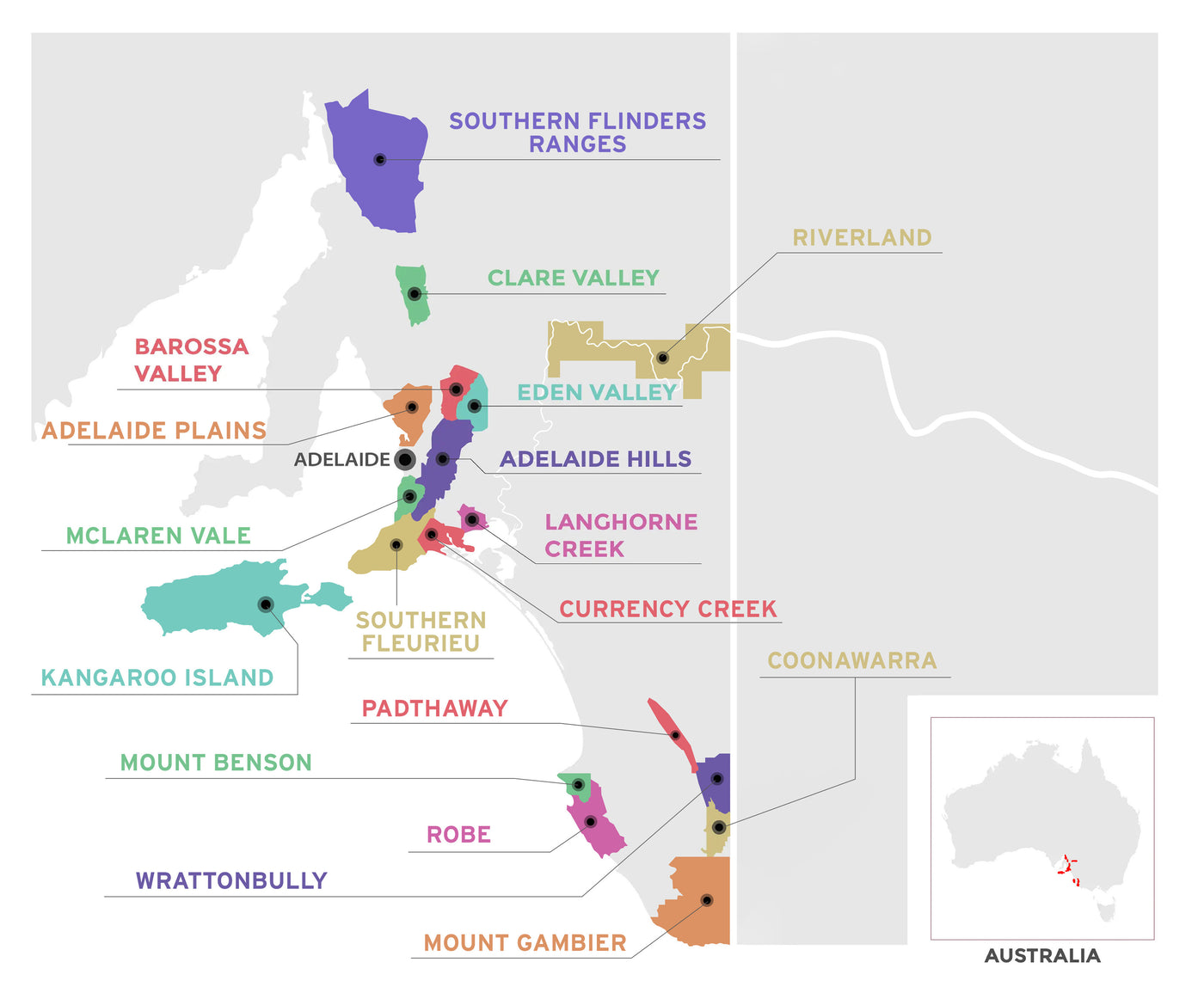
South Australia
South Australian is responsible for more than half the production of all Australian wine. It is home to more than 900 wineries across 18 wine regions. The regions are Adelaide Hills, Adelaide Plains, Barossa Valley, Clare Valley, Coonawarra, Currency Creek, Eden Valley, Kangaroo Island, Langhorne Creek, McLaren Vale, Mount Benson, Mount Gambier, Padthaway, Riverland, Robe, Southern Fleurieu, Southern Flinders Ranges and Wrattonbully.
Many of the well-known names in the South Australian wine industry established their first vineyards in the late 1830s and early 1840s. The first vines in McLaren Vale were planted at Reynella in 1839 and Penfold's established Magill Estate on the outskirts of Adelaide in 1844.
South Australia has a vast diversity in geography and climate which allows the State to be able to produce a range of grape varieties - from cool climate Riesling in the Clare and Eden Vallies to the big, full bodied Shiraz wines of the Barossa Valley and McLaren Vale. Two of Australia's best-known wines, Penfolds Grange and Henschke Hill of Grace, are produced here. There is much to discover in South Australia for the wine lover.