


Penfolds RWT Shiraz 2023
Style: Red Wine
Variety: Shiraz
Closure: Cork
Penfolds RWT Shiraz 2023
Warehouse
34 Redland Drive
Vermont VIC 3133
Australia
Critic Score: 97 and 19/20
Alcohol: 14.5%
Size: 750 ml
Drink by: 2050
Penfolds RWT Shiraz presents an admirable alternative to the multi-regional sourcing and American oak maturation that are hallmarks of Grange, expressing instead, single-region Barossa Valley Shiraz matured only in French oak. The initials RWT stand for 'Red Winemaking Trial', the name given to the project internally when developmental work began in 1995. The inaugral RWT Shiraz was launched in May 2000 with the 1997 vintage. Its style is opulent and fleshy, contrasting with Grange, which is more muscular and assertive.
"All plush fruit and textural nuance. This is a great release for the RWT Bin 798, Penfolds' finely tuned, contemporary rendition of Barossa Valley shiraz. Magenta-splashed crimson with fruit tones of satsuma plum, black cherry, blueberry and boysenberry along with hints of baking spices, chocolate cake, olive tapenade, dark chocolate, sandalwood, graphite, crushed rock, wood spice and cedar. The earthy and creamy flavours are beautifully balanced on the palate. The flow of fruit is long and true, with fine, powdery tannins poised perfectly as the wine trails off. This is a gorgeous drink now but will cellar beautifully over the next several decades." Dave Brookes
RWT is typically inky and deep in colour, with sumptuous fruit sweetness, mouth-filling flavours, underlying spice, savoury nuances and chocolaty tannins. The 2023 Penfolds RWT Shiraz is a 100% shiraz from premium vineyards in the Barossa Valley. The wine was matured for 14 months in French oak hogsheads (69% new, 31% one-year-old). The result is a wine that helps to redefine Barossa shiraz at the highest quality level.
Expert reviews
"All plush fruit and textural nuance. This is a great release for the RWT Bin 798, Penfolds' finely tuned, contemporary rendition of Barossa Valley shiraz. Magenta-splashed crimson with fruit tones of satsuma plum, black cherry, blueberry and boysenberry along with hints of baking spices, chocolate cake, olive tapenade, dark chocolate, sandalwood, graphite, crushed rock, wood spice and cedar. The earthy and creamy flavours are beautifully balanced on the palate. The flow of fruit is long and true, with fine, powdery tannins poised perfectly as the wine trails off. This is a gorgeous drink now but will cellar beautifully over the next several decades. Drink by 2050." Dave Brookes, Halliday Wine Companion - 97 points
"Penfolds’ non-Grange Barossa Shiraz. 100% French oak, all hogsheads, with 69% new, the remaining 31% one-year-old, this cracking red certainly exceeds what the vintage might be expected to offer. A very dark purple magenta, plenty of oak here, but early days and all is proceeding according to plan. Along with those vanillin notes on the nose, we have a touch of toast, dark chocolate, espresso, mocha, aniseed, bay leaves, a burst of ripe raspberries, blackberries and root vegetables. There are spices – notably a whiff of black pepper and nutmeg. So young, time will very much be to its benefit. Anyone leaving this wine in the cellar for the next five to six years before opening will reap the rewards. A move to the palate sees the wine give the impression of being more approachable than at first it seems – time is the key here. The wine is seamless, of medium weight and good length, with fine tannins and a finish which lingers beautifully, with roasted coffee notes. This is a very fine RWT. A twenty to twenty-five year proposition." Ken Gargett, Wine Pilot - 97 points
"The liberal use of French oak complements this wine, and it manages to tame the tannins without overpowering the fruit. RWT oscillates between raucously OTT performances and more measured, stealthy ones. This 2023 is a calm and civilised wine, with impressive depth of flavour and beautiful refinement throughout. Lovers of bigger, more ostentatious wines will perhaps find this a little too composed and demure, with not as much son et lumière as they might be looking for. Conversely, palates seeking detail and sophistication need look no further." Matthew Jukes - 18.5/20 points
"Deep, dense, saturated purple-red colour; aromas of dry earth, broken rocks and hints of chocolate and mocha. Concentrated and powerful, densely packed with flavour and tannins, fleshy and ample, the tannins coating the entire mouth. A muscular wine, firm and authoritative, long on the follow-through. Drink: 2028–2048." Huon Hooke, The Real Review - 97 points
"Polished and focused aromas of blackcurrants, crushed stones, blueberries, cedar, tobacco leaves and iodine. The palate is full-bodied with seamlessly integrated tannins and a silky mouthfeel that persists in a long, fragrant and deeply complex finish. Pure, refined and clear. Drink or hold." James Suckling, JamesSuckling.com - 97 points
"Deep crimson. Classic blackberry dark chocolate aromas with marzipan, hint violet notes. Well-concentrated and inky deep with plentiful blackberry pastille, praline flavours, plentiful chalky / graphite/ al-dente tannins, very good mid-plate density and well-balanced marzipan, roasted chestnut notes. Finishes chocolaty with some cedarwood/ bittersweet notes. Still in parts, but lovely shape, volume and flow. Should develop very well. Drink 2028 – 2045." Andrew Caillard MW - 96+ points
"Retains that new oak smell and feel. Indeed, 14 months in French oak hogsheads (69% new) is towards the higher end of oak for RWT (but not as high as 83% in the 2015), and has contributed not only a healthy dose of cedary, woody spice aromas, but helped emphasise the sweetness of ripe Barossa blueberry, red berried, cassis fruit accompanied by a whiff of earthy savouriness. Arrives fresh and lively, offering a warm Barossa welcome. This is one engaging RWT, on the full charm offensive with its ripe plums and dark fruits, heady spices, chocolate pan forte qualities and oh so smart – and expensive – vanillin, cedary oak qualities. It comes framed in fine pencil lead/graphite tannins that turn a little dry on the finish and remain steadfast throughout. RWT always has further ageing on its mind, especially so as a two-year-old. Drink: 2024-2047." Jeni Port, Wine Pilot - 96 points
"Viva la difference. So, here’s a Penfolds wine that is matured only in French oak with more than 60% new. It was quite a style departure when first released. It is certainly one of the most elegant and stylish of recent vintages, reflecting the season. The colour is bright and lively with red and light crimson hues. Aromas of high-end floral and spices emerge immediately. The palate opens with typical dark plum and blackberry fruits, but then lifted red fruit characters of cranberry and redcurrant emerge. Defined and controlled through to a very long finish. Cellar 25 years." Ray jordan - 96 points
"Struck by the redness of the fruit here, married to cedarwood, roasted nuts and milk chocolate, the plum flavours plumbed thoroughly through with raspberry and red licorice. The flavour is generous, the balance immaculate, the finish fine-grained and extended. It’s a straightforward wine in some ways, which counterintuitively is a positive here. It nails its brief in emphatic terms, and yet it keeps the tone bright. My note from the tasting concluded with the words "95 in a canter, so maybe 96". Drink: 2027-2040+." Campbell Mattinson, The Wine Front - 95+ points
"Intoxicating, exotic notes of sandalwood and Tahitian vanilla pods lead the way on the nose. The palate has already reached a compromise with the oak, showcasing a mineral, graphite-like backbone complemented by well-polished, generous dark fruit. Blueberry yogurt, mulberry conserve, blackberries, cherry cola, some crème brûlée, and cedar. It’s very much representative of that bon vivant style that Barossa does best, and it will need plenty of time to fully express each of its colour shades." Lisa Cardelli, Wine Pilot - 95 points
"The 2023 RWT Bin 798 hails from the Barossa Valley, and the wine expounds the virtues of the place there: earthy tannins, powerful and robust fruit and great length of flavor. There is elegance here, but it is couched within structure and thrust. Dryness in the form of cedar and sweetness in line with woody sandalwood back the fruit and form of the wine. It matured for 14 months in French oak hogsheads, 69% new. 14.5% alcohol, sealed under natural cork. Drink: 2025-2043." Erin Larkin, Wine Advocate - 95 points
The story of rwt

Penfolds RWT Bin 798 Barossa Valley Shiraz, first made in 1997, was released after several years of red winemaking trials from which the wine takes its name. Since the 2014 vintage it has been allocated Bin number 798, based on the alpha-numeric telephone punch dial, to reflect its established status within the Penfolds wine portfolio.
The fruit is sourced exclusively from the best vineyards in the Barossa Valley, where ripening conditions particularly suit the Penfolds House Style. These include the Kalimna, Koonunga Hill, Moppa, Marananga and Ebenezer vineyards. The overall winemaking process is almost identical to Grange, however, unlike Grange, it is matured only in French oak. The maturation includes partial barrel fermentation for 12 to 15 months in 50-70% new French oak hogsheads (300 litres). These wines are built for the long haul, with the precision, concentration and balance to age for many years – the best vintages will last at least 30.
"RWT Bin 798 celebrates Barossa bloodlines and the graceful elegance of French oak. This is no longer a trial but a stand-alone Penfolds red that embodies regional provenance and now has its own track record" Andrew Baldwin, Winemaker
“An ode to the Barossa with all that beautiful power and depth.” Nick Ryan, Penfolds Rewards of Patience tasting panel member
Peter Gago

The following text is taken from an article by Ken Gargett in Quill & Pad, https://quillandpad.com
Peter Gago has what many people in the wine world think is the best job on the planet. He is chief winemaker for Penfolds, based in South Australia and one of Australia’s oldest wine producers.
Max Schubert created Grange with the experimental first wine, the 1951, after he returned from Bordeaux and wanted to establish an Aussie First Growth. The story of Grange has been told many times, and as fascinating as it is I won’t rehash it again. Schubert ruled at Penfolds right through to the 1976 vintage, when he handed the reins to Don Ditter. Ditter made the wines right through to the 1986 vintage when John Duval stepped up. Duval was chief winemaker until the 2002 vintage, when he left to do his own thing, very successfully.
Since that time, Peter Gago has been the chief winemaker. It should be noted that although the role of chief winemaker at Penfolds will always be inextricably linked with Grange, there are a great many other wines in the portfolio for which this position assumes ultimate responsibility.
Alongside the winemaking, in which he is still heavily involved, a usual week in non-Covid times sees Gago flying around the world to tastings, dinners, events, festivals, and promotions. I suspect that only David Attenborough (outside of pilots and crew) has racked up more flying miles. I remember seeing him one day when he seemed even more pleased with the world than usual. Turns out he’d just run into his wife, Gail, now retired but a long-term and highly regarded member of the South Australian parliament, at the airport. Gago had not been aware that they would both be in the same country that week, let alone cross paths, such is his usual peripatetic lifestyle.
Gago has friends and admirers all around the globe, from the rich and famous to young, aspiring wine lovers, and will spend time talking to them all. I suspect that if he wanted to start dropping names, the din would reverberate for days, but you could not find a humbler man. Gago is a serious music buff and you’d be amazed at the number of rock stars who revere him, much in the way their fans might do for them (for instance, after crawling over broken glass to get a ticket to a Bruce Springsteen concert I saw Gago sitting in prime seats with Springsteen’s family, after which they went for dinner and knocked off a few bottles of Grange).
Gago is probably as close to a rock star himself in the world of wine, although perhaps more modest rather than flamboyant. And I have no idea if he can sing.
The thing that most amazes me with Gago is that every time you talk to him, he is bubbling with genuine enthusiasm, not just for Grange but for all his wines. He just loves what he is doing. One gets the feeling that every morning he wakes up and pinches himself to make sure it is real.
Among his many attributes, Gago has the gift of the gab like few others. Only once have I ever seen him lost for words and caught off guard. Many years ago, at the annual release – held in a very fancy location near the shores of Sydney Harbor; it is always a fancy location somewhere and also always includes great champagne to kick off the day as Gago is fanatical about the world’s best bubbles – the then current chairman or CEO of whichever corporate entity was then the owner of Penfolds attended the day. Forgive me for my failure to remember just where the corporate snakes and ladders left Penfolds that day and for failing to remember the relevant gentleman’s name. He had only been appointed as a temporary executive while the search for a more permanent one was ongoing, but unlike any of the CEOs before and after, this man had a genuine interest and came to a couple of tastings to learn.
Anyway, as we sipped our champagne on the lawns overlooking Sydney Harbor and chatted, our friend suddenly posed a question to Gago. He had been meaning to ask, he said, just how much Grange the company made. There were five or six writers in this little group and suddenly, every single one of us had pad and pen poised. The production of Grange is a national secret that is not to be disclosed under pain of death (general consensus puts it at, depending on the vintage, between 5,000 and 15,000 cases, with most releases in the mid range, but this is pure speculation).
Gago was at a loss. The boss of bosses had just asked him a direct question and Gago is far too polite not to answer but knew he couldn’t give that information out in public. He managed a fair bit of mumbling and generalizations and I think he suggested they meet later. Pads and pens all went back into bags, and we could not help grinning while Gago looked like he’d just swallowed a bad oyster.
Gago was born in England in 1957, but his family moved to Melbourne when he was only six years of age. Originally a math teacher (teaching is still a passion), he undertook a science degree at the University of Melbourne and then attended Roseworthy College, a famous Australian winemaking college, graduating as Dux (the highest ranking academic performance -ed), which will surprise no one.
In 1989 he joined Penfolds as a sparkling winemaker, working with Ed Carr, who has established a career in sparkling wine (now with Arras) as successful as Gago’s is with table wines. He moved to reds and quickly rose through the ranks until succeeding Duval in 2002. In the 73 years since Schubert was first appointed, Gago is only the fourth chief winemaker.
During his tenure, he has stacked up an extraordinary array of bling, as has Penfolds under his stewardship (Gago heads a team of eight winemakers for table wines and a couple more for fortifieds). He has several “Winemaker of the Year” awards from different entities and publications, both from Australia and abroad, but the accolades go well beyond that.
In 2017, in what is termed “the Queen’s Birthday Honors List,” he was awarded the highly prestigious Companion of the Order of Australia (AC) for service to the wine industry. For non-Aussies, that is a big one! A year later, he received an honorary doctorate from the University of South Australia and named the Great Wine Capitals Ambassador for South Australia.
Very recently, Gago was awarded perhaps the most prestigious honor of all in the wine world: admission to the Decanter Hall of Fame (previously they honored the Decanter Man – or Woman – of the Year, but that changed). Decanter is a highly respected English wine magazine that established its hall of fame in 1984 with Serge Hochar from Château Musar in Lebanon the first recipient. There is only a single addition per year. Gago is the fourth Australian following Max Schubert in 1988, Len Evans in 1997, and Brian Croser in 2004. That two of the four chief winemakers from a single producer have made this list (Schubert and Gago) is unprecedented but shows just where Penfolds sits in the pantheon of wine producers around the globe.
And should you still remain unconvinced then take a moment to look at some of the names Gago has joined: Parker, Spurrier, Tchelistcheff, Robinson, Moueix, de Villaine, Antinori, Lichine, Gaja, Symington, Loosen, Guigal, Torres, Draper, Peynaud, Mondavi, and so many more. There is no question that the name Peter Gago sits very comfortably alongside them all.
What is most important is that across the board the Penfolds wines have never been better, and while it is a team effort, in the end we can thank Gago.
About the winery

After the success of early sherries and fortified wines, founders Dr Christopher and Mary Penfold planted the vine cuttings they had carried on their voyage over to Australia. In 1844 the fledging vineyard was officially established as the Penfolds wine company at Magill Estate.
As the company grew, so too did Dr Penfold's medical reputation, leaving much of the running of the winery to Mary Penfold. Early forays into Clarets and Rieslings proved increasingly popular, and on Christopher's death in 1870, Mary assumed total responsibility for the winery. Mary's reign at the helm of Penfolds saw years of determination and endeavour.
By the time Mary Penfold retired in 1884 (ceding management to her daughter, Georgina) Penfolds was producing 1/3 of all South Australia's wine. She'd set an agenda that continues today, experimenting with new methods in wine production. By Mary's death in 1896, the Penfolds legacy was well on its way to fruition. By 1907, Penfolds had become South Australia's largest winery.
In 1948, history was made again as Max Schubert became the company's first Chief Winemaker. A loyal company man and true innovator, Schubert would propel Penfolds onto the global stage with his experimentation of long-lasting wines - the creation of Penfolds Grange in the 1950s.
In 1959 (while Schubert was perfecting his Grange experiment in secret), the tradition of ‘bin wines' began. The first, a Shiraz wine with the grapes of the company's own Barossa Valley vineyards was simply named after the storage area of the cellars where it is aged. And so Kalimna Bin 28 becomes the first official Penfolds Bin number wine.
In 1960, the Penfolds board instructed Max Schubert to officially re-start production on Grange. His determination and the quality of the aged wine had won them over.
Soon, the medals began flowing and Grange quickly became one of the most revered wines around the world. In 1988 Schubert was named Decanter Magazine's Man of the Year, and on the 50th anniversary of its birth, Penfolds Grange was given a heritage listing in South Australia.
Despite great success, Penfolds never rests on its laurels. In 2012 Penfolds released its most innovative project to date - 12 handcrafted ampoules of the rare 2004 Kalimna Block Cabernet Sauvignon.
Two years later, Penfolds celebrated the 170th anniversary – having just picked up a perfect score of 100 for the 2008 Grange in two of the world's most influential wine magazines. Today, Penfolds continues to hold dear the philosophies and legends – ‘1844 to evermore!'.
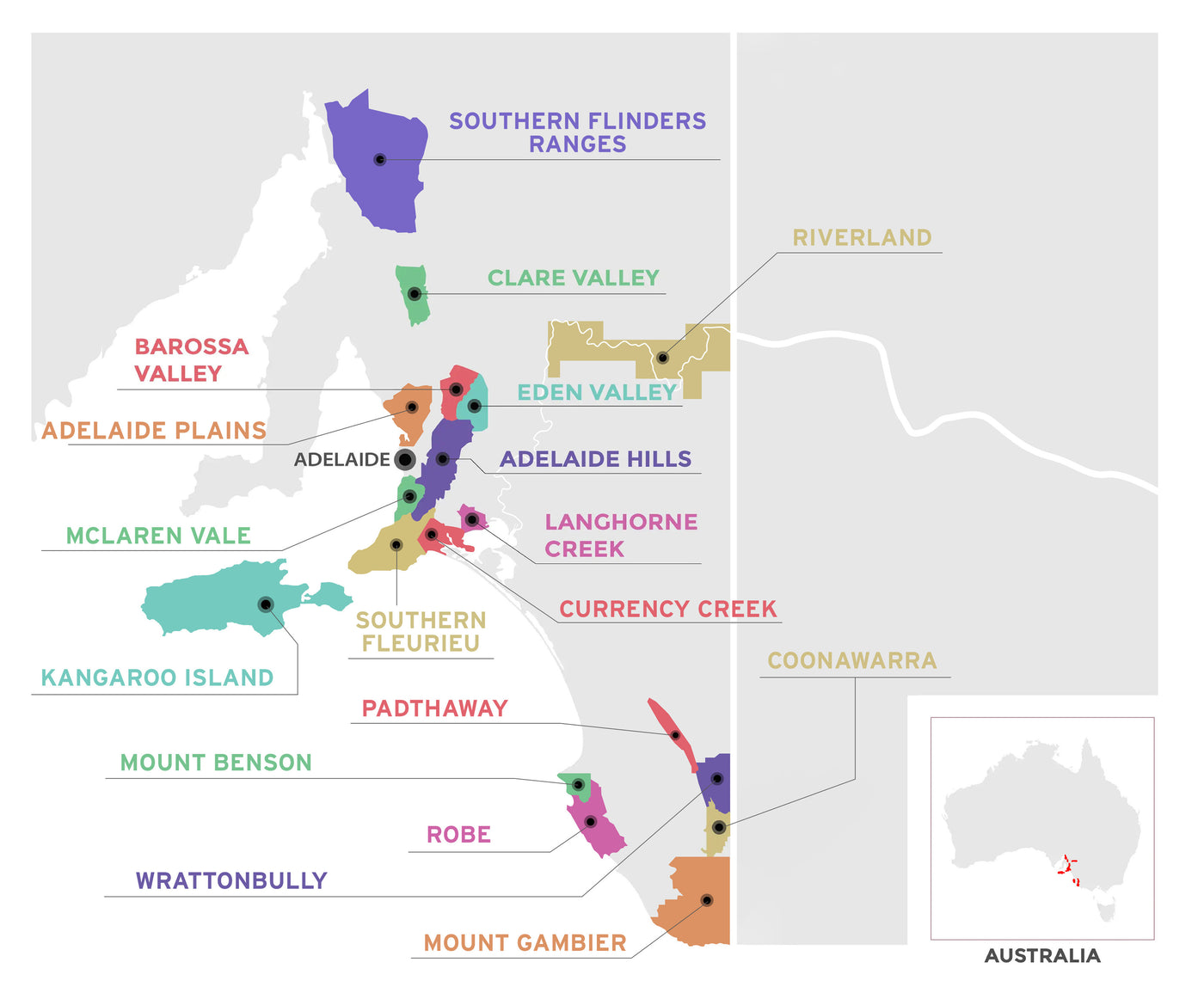
South Australia
South Australian is responsible for more than half the production of all Australian wine. It is home to more than 900 wineries across 18 wine regions. The regions are Adelaide Hills, Adelaide Plains, Barossa Valley, Clare Valley, Coonawarra, Currency Creek, Eden Valley, Kangaroo Island, Langhorne Creek, McLaren Vale, Mount Benson, Mount Gambier, Padthaway, Riverland, Robe, Southern Fleurieu, Southern Flinders Ranges and Wrattonbully.
Many of the well-known names in the South Australian wine industry established their first vineyards in the late 1830s and early 1840s. The first vines in McLaren Vale were planted at Reynella in 1839 and Penfold's established Magill Estate on the outskirts of Adelaide in 1844.
South Australia has a vast diversity in geography and climate which allows the State to be able to produce a range of grape varieties - from cool climate Riesling in the Clare and Eden Vallies to the big, full bodied Shiraz wines of the Barossa Valley and McLaren Vale. Two of Australia's best-known wines, Penfolds Grange and Henschke Hill of Grace, are produced here. There is much to discover in South Australia for the wine lover.