


Te Mata Estate Coleraine 2024 (1500ml)
Style: Red Wine
Closure: DIAM Cork
Te Mata Estate Coleraine 2024 (1500ml)
Warehouse
34 Redland Drive
Vermont VIC 3133
Australia
Critic Score: 100
Alcohol: 13.5%
Size: 1500 ml
Drink by: 2075
"A masterpiece. Has scintillating fruit purity and exceptional depth." Sam Kim
"An utterly delicious cabernet blend. A top vintage of this wine." Huon Hooke
"Majestically long, equal parts power, elegance and poise." Stephen Wong
"Superlative balance. So caressing and polished." James Suckling
"An exceptional wine." Gary Walsh
Te Mata Estate was acquired by John Buck in 1974 and the Buck family have been producing Te Mata wines ever since. Coleraine is named after John's family ancestral hometown in Northern Ireland. Coleraine is Te Mata Estate's flagship wine and is regarded by many as New Zealand's finest red wine. First produced in 1982, Coleraine is a classic blend of cabernet sauvignon, merlot and cabernet franc.
"This is a masterpiece, much like a great work of art. The bouquet shows cassis, dark plum, bouquet garni, baking spice, rich floral, and cedar characters. It’s concentrated with exceptional depth and mouth-coating texture, wonderfully framed by finely polished tannins. It’s perfectly proportioned and gracefully powerful, combining scintillating fruit purity with seductive complexity. The wine flows seamlessly to a persistent, structured finish." Sam Kim
The 2024 comprises 58% cabernet sauvignon, 31% merlot and 11% cabernet franc.
"If the Langton's Classification crossed the Tasman, Te Mata Coleraine would sit alongside Grange at its very pinnacle. Established, esteemed, outstanding – vintage after vintage, the glowing adjectives come thick and fast." Langtons
"A deep, brilliant crimson with a vibrant purple core, Coleraine ’24 opens with an alluring bouquet of fresh roses, cassis, dark cherries and blackberries. Layers of dark chocolate, nori, black olive and subtle cedar add complexity, while lifted florals and a savoury coastal nuance enhance its depth, precision and beauty. On the palate, a concentrated wave of red and dark fruit flows over velvety, cocoa powder textures, as expansive, silky tannins weave seamlessly through the wine. This enormity of scale is highlighted by a fine, focused acid line that drives through to a finish of exceptional length. With immense power held in delicate restraint, Coleraine ’24 is destined to unfurl over decades." Te Mata Estate

Te Mata Estate Winery
Expert reviews
"This is a masterpiece, much like a great work of art. The bouquet shows cassis, dark plum, bouquet garni, baking spice, rich floral, and cedar characters. It’s concentrated with exceptional depth and mouth-coating texture, wonderfully framed by finely polished tannins. It’s perfectly proportioned and gracefully powerful, combining scintillating fruit purity with seductive complexity. The wine flows seamlessly to a persistent, structured finish." Sam Kim, Wine Orbit – 100 points
"Deep and bright, bold purple-red colour; fabulous cranberry, violet and cassis aromas, the fruit bursting from the glass. The same flavours saturate the palate which is beautifuly balanced by abundant fine-grained tannins that run the full length of the palate and provide a very long lasting and resonant farewell. Oak is so well handled as to be only just perceptible, adding to the cedary touches. An utterly delicious cabernet blend and a top vintage of this wine. Drink: 2026-2046." Huon Hooke, The Real Review - 98 points
"Superlative balance. Aromas of blackberries, currants, blueberries, graphite and dark tobacco with hints of bark, violets and licorice. Medium-bodied with ultra-fine velvety tannins and a seamless, cashmere texture. So caressing and polished. Bright and vivid at the end. 58% cabernet sauvignon. 31% merlot and 11% cabernet franc. Will be released March 1. You could drink this tonight and enjoy it, but it will age." James Suckling, Jamessuckling.com - 98 points
"This is 58% Cabernet Sauvignon, 31% Merlot and 11% Cabernet Franc. 55% new oak. This vintage puts me in mind of the mighty 2020; that sort of depth and concentration, though it has some of the acid cut of 2021 in the mix too. Winemaker Phil Brodie says 2024 was a dry vintage, and warm too, with small bunches and lower crop levels. Said it could have gone too ripe, but they walked through the vineyards on a daily basis, tasting and testing, and they picked it when they thought it was just right. When I think about NZ wine, at the top of the tree, I have Kumeu for Chardonnay, Bilancia for Shiraz (and sometimes Chardonnay!), and Te Mata for Cabernet. A trio of meticulous producers who regularly deliver that little bit extra. The one percenters, if you like.
Deep dark wine, black and red fruit, chocolate and ironstone, some creamy and spicy cedar oak, dried flowers, a light minty perfume, slight roasted red capsicum and pimento. It’s medium to full-bodied, crisp 'mineral' acidity, lavish graphite tannin, tobacco and nori, a fresh blackberry nip to it, brooding and ferrous, with a firm and savoury finish of superb length. An exceptional wine. It will keep, probably, for as long as you want to keep it, if you can keep your hands off it, that is. Drink: 2028-2049+." Gary Walsh, The Wine Front - 97+ points
"Deep ruby with a purple rim. Quite closed and reticent until given considerable aeration and time in the glass. Once unfurled, this displays impressive amounts of restrained power, depth and persistence. The compact core of blackcurrant, rose and raspberry is swaddled in gossamer layers of cedar, dried tobacco, freshly ground coffee, dried orange peel and wet stone. Everything is precisely balanced and polished to sleekness; the firmly structural tannins and oak completely submerged and velvety. Majestically long yet not a blockbuster, the finish unfolds like a symphony, reprising every nuance and flavour hidden within its youthful shell, equal parts power, elegance and poise. Arguably approachable now but it will be considerably better with a few years in bottle. Drink: 2031-2051+." Stephen Wong, The Real Review - 97 points
The story of coleraine

Te Mata Estate was acquired by John Buck in 1974 and the Buck family have been producing Te Mata wines ever since. Coleraine is named after John's family ancestral hometown in Northern Ireland.
"Coleraine is New Zealand's greatest red wine" - Sydney Morning Herald
Coleraine is Te Mata Estate's flagship wine and is regarded by many as New Zealand's finest red wine. First produced in 1982, Coleraine is a classic blend of cabernet sauvignon, merlot and cabernet franc, and displays the concentration, complexity and elegance found in the world's greatest wines. Coleraine showed the world that Hawke's Bay, and indeed New Zealand, was capable of making world class red blends.
Cabernet Sauvignon is nearly always the dominant grape variety but the blend has ranged from 94% Cabernet Sauvignon in 1982 down to just 25% in 2002. The remainder of the blend is predominantly Merlot with, usually, the addition of small amounts of Cabernet Franc.
The earlier vintages of Coleraine from 1982 to 1988 were all single-vineyard blends from the Coleraine vineyard. From 1989 onwards, the wine has been a blend of grapes from across the Te Mata Estate vineyards that were planted in 1982.
Peter Cowley joined Te Mata as their sole winemaker in 1984, two years after Coleraine's inaugural vintage. He has been responsible for all the subsequent vintages until his retirement in 2019. Peter handed over the reins to now senior winemaker Philip Brodie, who has been part of the Te Mata Estate team since 1992.
"The absolute strength of Bordeaux blends is in different varieties and different soils, and that's where we started. But it is also really about the people that put these wines together, who made them what they are.
Although it might have been inspired by Bordeaux, the thing about Coleraine is that it has really come out of that shadow and it has developed its own voice and style in that time. When you go through 32 years of Coleraine, we are looking at New Zealand history – we are stepping out of the shadow of Bordeaux and taking pride in New Zealand." Toby Buck, Te Mata Estate

Nick Buck discusses Coleraine
About the winery

Te Mata Estate was established in 1896, specialising in high-quality wines of classical style. The winery remains family owned, producing internationally recognized wines exclusively from its Hawke's Bay vineyards.
"New Zealand's first growth" - Andy Howard MW, Decanter Magazine
"A national treasure" - Jancis Robinson MW
"New Zealand's greatest winery" - Robert Parker's Wine Advocate
Te Mata Estate was originally part of Te Mata Station, a large pastoral land-holding established by English immigrant, John Chambers, in 1854. After returning from France, John Chamber's third son, Bernard, had the idea to plant vineyards on the north-facing hills around Havelock North. In 1892 he planted vines on three parcels of hillside land above the homestead and began converting the original stables to ferment and mature the wines. The first vintage wines were released in 1986. Today, Te Mata Estate still uses those same three vineyards.
The Chambers family sold the property in 1919. The property had two other owners until John and Wendy Buck acquired Te Mata Estate in 1978 and instigated a twenty-year development program, which commenced with the restoration of the original winery building and the replanting of all of the original vineyards. In addition, new vineyard sites were acquired in the Bridge Pa, Gimblett Gravels and Dartmoor Valley sub-regions of Hawke's Bay (refer map below). The Buck family have been producing Te Mata wines ever since. The success of Te Mata's wines in the '80s is credited with sparking the revival of Hawke's Bay as a top wine region.

Te Mata Estate Winery and Hawke's Bay sub-regions
New Zealand
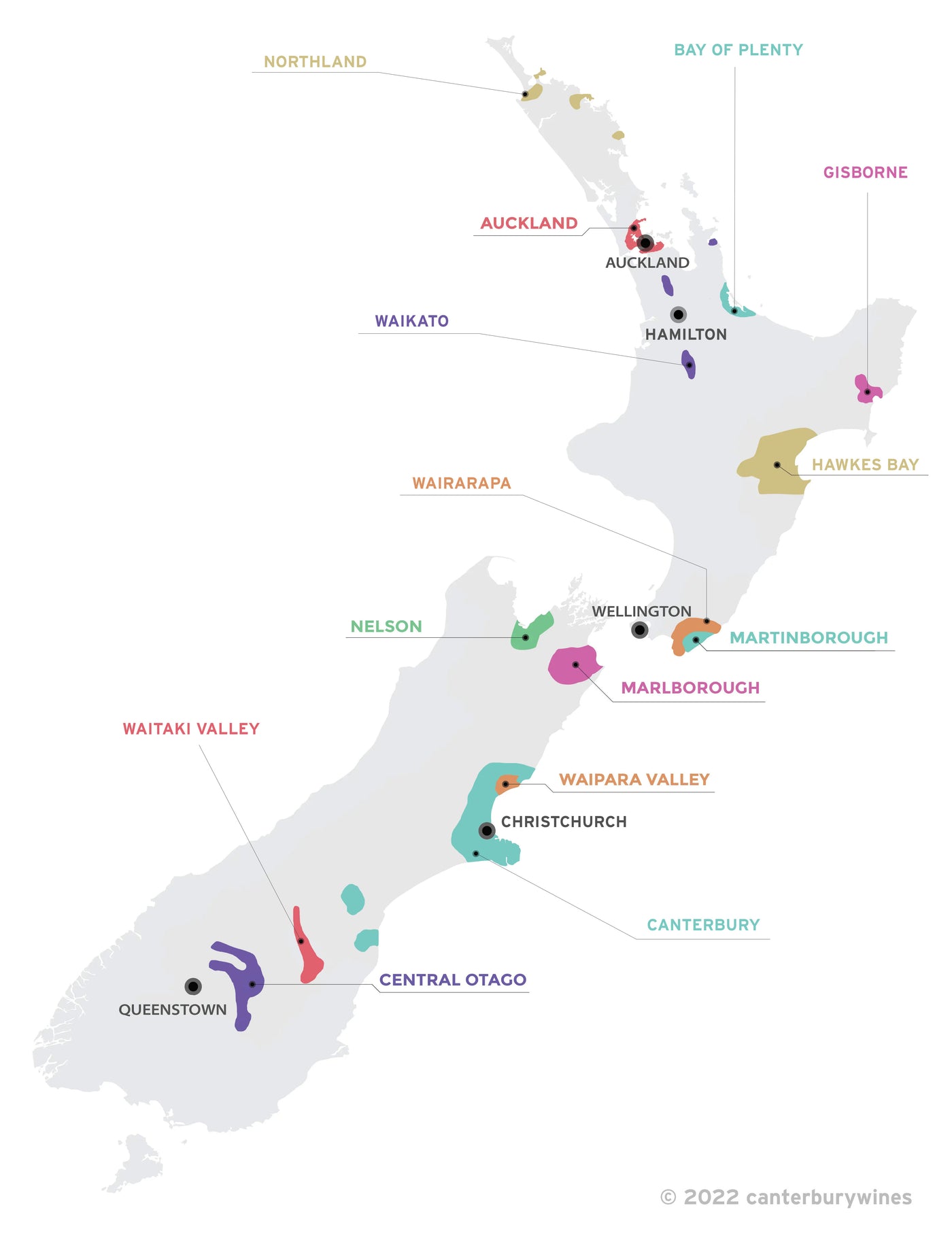
New Zealand is home to more than 700 wineries across 14 wine regions. The regions are Auckland, Bay of Plenty, Canterbury, Central Otago, Gisborne, Hawkes Bay, Marlborough, Martinborough*, Nelson, Northland, Waikato, Waipara Valley, Wairarapa and Waitaki Valley. * Martinborough is a sub-region of Wairarapa, however, as it is world renowned it is considered here to be a region to avoid confusion.
The wine regions in New Zealand stretch from latitudes 36°S (Northland) in the north (comparable in latitude to Jerez, Spain), to 45°S (Central Otago) in the south (comparable in latitude to Bordeaux, France). New Zealand's climate is maritime, producing cooler summers and milder winters than would be expected at similar latitudes in Europe.
Viticulture in New Zealand dates back to 1836 when British resident James Busby produced wine in the far north, but it wasn't until 1985 that the wine industry came of age when Cloudy Bay Sauvignon Blanc garnered international attention and critical acclaim.
New Zealand is internationally renowned for Sauvignon Blanc (particularly from Marlborough), Pinot Noir (Central Otago, Martinborough and Waipara Valley), Chardonnay, Bordeaux-style blends of mainly Merlot and Cabernet Sauvignon (Hawkes Bay) and Syrah (Hawkes Bay). Sauvignon Blanc accounts for 63% of the area of the national vineyard, followed by Pinot Noir (14%), Chardonnay (8%), Pinot Gris (7%) and Merlot (3%).