


Terra Sancta Mysterious Diggings Pinot Noir 2024
Style: Red Wine
Closure: Screwcap
Terra Sancta Mysterious Diggings Pinot Noir 2024
Warehouse
34 Redland Drive
Vermont VIC 3133
Australia
Producer: Terra Sancta
Country: New Zealand
Region: Central Otago
Vintage: 2024
Critic Score: 98
Alcohol: 13.0%
Size: 750 ml
Drink by: 2032
James Suckling Top 100 Wines of the World 2025 (#4)
James Suckling Top 100 Wines of the New Zealand 2025 (#1)
James Suckling Top 100 Value Wines of the World 2025 (#2)
"The Terra Sancta Mysterious Diggings Pinot Noir 2024 is a stunning wine." James Suckling
Terra Sancta means special place. At the far end of iconic Felton Road, one of New Zealand's most celebrated wine addresses, lies Terra Sancta Estate - home to the first vines planted in Bannockburn in 1991. Pinot Noir is produced in three tiers: the three flagship Single Block wines, the Estate wine from the Terra Sancta Estate and the Mysterious Diggings Pinot Noir. Fruit for the latter is sourced from the Mysterious Diggings Vineyard, a high-altitude, north facing site situated at 300 metres above sea level that was planted in 1999.
"Incredibly intense aromas of cherries, strawberries, peaches, melon and fresh flowers. Medium-bodied with creamy, open-grained tannins and a juicy finish. Refreshing, vivid and vibrant. A pinot noir for today. From a mix of clones on their own roots planted in 1999 and farmed organically." James Suckling
"I visited Terra Sancta two weeks ago in the New Zealand town of Bannockburn, Central Otago, and the vineyards – mostly ungrafted and planted in the early 1990s – were among the most beautiful I’ve ever seen, with organic and regenerative viticulture. I’m still shaking my head in disbelief." James Suckling
"Crafted from vineyard to bottle by Terra Sancta, this 100% Bannockburn Pinot Noir embodies the character of our highest altitude site, the Mysterious Diggings Vineyard. At 300 metres above sea level, vines rooted in sandy soils produce fruit of remarkable clarity and vibrancy. Fermented with 100% native yeasts, our focus is on preserving the natural energy and beauty of the fruit. The result is a pure, expressive Pinot Noir - vivid, balanced and alive with the character of Bannockburn." Terra Sancta
Expert reviews
"Incredibly intense aromas of cherries, strawberries, peaches, melon and fresh flowers. Medium-bodied with creamy, open-grained tannins and a juicy finish. Refreshing, vivid and vibrant. A pinot noir for today. From a mix of clones on their own roots planted in 1999 and farmed organically. Drink or hold. Screw cap." James Suckling, Jamessuckling.com - 98 points and Top 100 Wines of the World 2025 (#4) and Top 100 Wines of the New Zealand 2025 (#1) and Top 100 Value Wines of the World 2025 (#2)
Awards
James Suckling Top 100 Wines of the World 2025 (#4)
James Suckling Top 100 Wines of the New Zealand 2025 (#1)
James Suckling Top 100 Value Wines of the World 2025 (#2)
Central Otago

Rippon Vineyard in the Wanaka sub-region of Central Otago
Central Otago on New Zealand’s South Island is famous for wine, especially Pinot Noir. It is New Zealand’s most glamorous wine region. Wine has been produced in this rugged, mountainous region since the heady days of the 1860s Gold Rush.
Central Otago is the third largest wine region in New Zealand with 2,024 hectares (ha) planted to vines, a long way behind Hawke’s Bay (4,643 ha) and Marlborough (28,360 ha). In Cental Otago, 80% of the vineyard area is devoted to pinot noir, which continues to enjoy steady growth. Pinot gris is second with a little over 8% of the total vineyard area, followed by chardonnay with a 4% share. Riesling, sauvignon blanc and gewürztraminer follow in that order.
Due to the region's diverse climate, soil and aspect, the growing areas are divided into seven distinct sub-regions, all offering a different expression of Central Otago Pinot Noir. The sub-regions are Alexandra, Bannockburn, Bendigo, Cromwell/Lowburn/Pisa, Gibbston Valley, Wanaka and Queensberry (refer to the maps below).
Alexandra
It all started in Alexandra in 1864 with the planting by Frenchman Jean Desire Feraud of his Monte Christo vineyard. Although the most southerly of all the Central Otago sub-regions, it is often the hottest. Alexandra regularly records the hottest temperatures in New Zealand.
The landscape is exotic and moon-like with rocky schist outcrops everywhere providing well draining mineral soil. However, it is the extreme variation in temperature between night and day that produces beautifully aromatic, finely structured wines. During the day the intense heat produces high sugar content in the grapes and the large drop in temperature overnight preserves the high natural acid content, creating exceptionally balanced fruit.
Gibbston Valley
Bannockburn is the most familiar sub-region in Central Otago, partly because of the success of Felton Road. This north-facing bowl lies at the foot of the Cromwell Basin just to the south of Cromwell township, on the southern bank of the Kawarau River as it widens and joins Lake Dunstan and the Clutha River.
This area is very hot and dry in the summer and the soil is particularly dusty and well drained. The landscape is strewn with old sluicing mounds from gold mining days long gone. The gold miners used to call this region "the heart of the desert". Harvest can be up to a month ahead of other sub-regions, and the wines produced are highly distinctive and complex.
Bendigo
North of Cromwell along the eastern shores of Lake Dunstan and the Cluthra River is the sub-region of Bendigo. It extends along the banks of the Clutha River before it feeds into the northeast end of Lake Dunstan, then along the southeastern bank of the lake, facing Pisa on the opposite side of the valley. Bendigo Pinot Noir is richly flavored with strong tannins and is amongst the most muscular, full-bodied wines made in Central Otago.
Cromwell/Lowburn/Pisa (Cromwell Basin)
This sub-region is located on the western side of Lake Dunstan stretching north for some 25km from the township of Cromwell. The majority of plantings are situated on the lower terraces and valley floor running parallel to the snow-capped Pisa mountain range. These vineyards produce a distinctively silky seductive style of wine.
Gibbston Valley
Situated east of Queenstown along the spectacular Kawarau Gorge, Gibbston is the highest sub-region in Central Otago with vineyards as high as 420 meters above sea level. Its cooler climate and north-facing hillside vines ripen later than neighbouring sub-regions, producing a lighter style wine. Site selection is critical as it is the coolest of all the sub-regions, but the right vineyard in the right hands grows exquisite fruit of great colour and intensity with wonderful finesse.
Wanaka
A couple of mountain ranges and 80km north of Queenstown, beautiful Wanaka is cooler and slightly wetter than the rest of the region. The massive Lake Wanaka provides a warming effect, often protecting the grapes from late frost. Wanaka has the smallest vine plantings of all the sub-regions. It has one spectacular vineyard with magnificent views over the lake, Rippon Vineyard. The sub-region produces delicate and vivid wines.

The winery

"I visited Terra Sancta two weeks ago in the New Zealand town of Bannockburn, Central Otago, and the vineyards – mostly ungrafted and planted in the early 1990s – were among the most beautiful I’ve ever seen, with organic and regenerative viticulture. I’m still shaking my head in disbelief." James Suckling
Terra Sancta means special place. At the far end of iconic Felton Road, one of New Zealand's most celebrated wine addresses, lies Terra Sancta Estate. The Estate is home to the first vines planted in Bannockburn in 1991 - the vineyards at that time belonged to the original winery, Olssens.
Mark Weldon and Sarah Eliott purchased the pioneering Olssens vineyards that became Terra Sancta in 2011. They significantly expanded the vineyards and constructed a winery on the property; the cellar door looks across vineyards to the mountain ranges beyond. They are passionate about Bannockburn which was selected after they were told "Get the best bit of dirt that you can because you can’t out-perform the vineyard."
They have four vineyards: Sancta Vineyard (planted in 1991) and Terra Vineyard (planted in 2001), which together make up Terra Sancta Estate; Mysterious Diggings Vineyard (planted in 1999), one of Bannockburn’s highest vineyards at 300 metres above sea level; and The Irrestible Race Vineyard planted in 2013.
The three flagship Single Block Pinot Noirs - Slapjack Block, Jackson's Block and Shingle Beach - and the Estate wines come from the Terra Sancta Estate; while the Mysterious Diggings Pinot Noir comes from the vineyard of the same name.
Mark and Sarah love old maps as they combine geography, science, art and some mystery. A lot like wine. He has an antique map from the world’s first atlas (1582) of Terra Sancta (Holy Land).”
We love old maps—they combine geography, science, art, and some mystery. A lot like wine. We have an antique map at our cellar door from the world’s first atlas (1582) of Terra Sancta (Holy Land). In the top right-hand corner of that map there is a cartouche, which visually tells the story of the place depicted in the map. We used the concept of a cartouche for our label—with our label designed to tell the story of our place and the wine in the bottle. Everything depicted, from the colours to the symbols, is connected to our vineyard and is a part of the story. Purple is the colour of the wild thyme on the vineyard. Gold represents the gold sluicings on Felton Road. The dog is our dog Miro, and the hawk presides over Lola’s Block. The fruits and flowers show characteristics found in our wines. The three circles represent our three single-block pinot noirs. Our labels are also a symbol of our dedication to detail, craft and care.
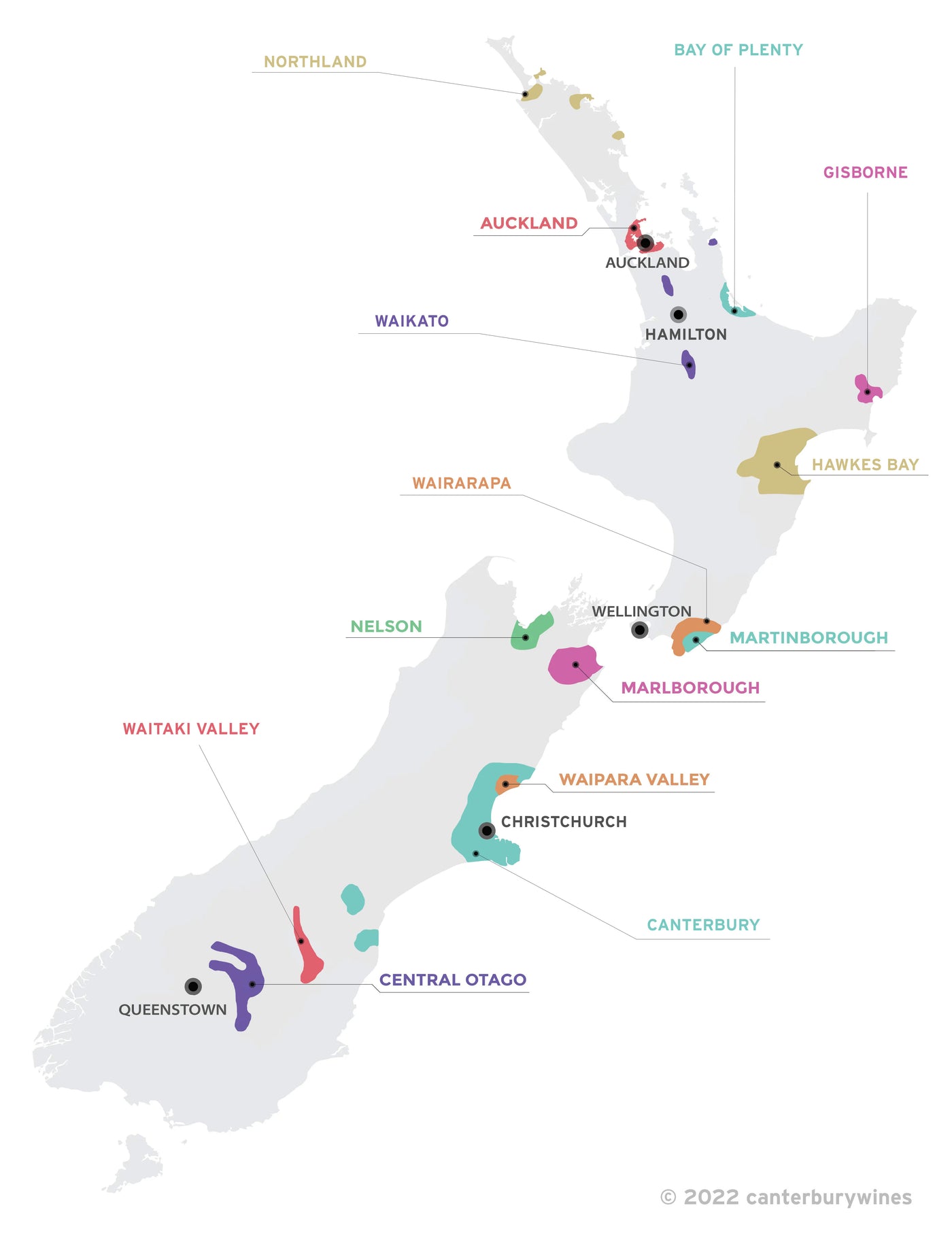
New Zealand
New Zealand is home to more than 700 wineries across 14 wine regions. The regions are Auckland, Bay of Plenty, Canterbury, Central Otago, Gisborne, Hawkes Bay, Marlborough, Martinborough*, Nelson, Northland, Waikato, Waipara Valley, Wairarapa and Waitaki Valley. * Martinborough is a sub-region of Wairarapa, however, as it is world renowned it is considered here to be a region to avoid confusion.
The wine regions in New Zealand stretch from latitudes 36°S (Northland) in the north (comparable in latitude to Jerez, Spain), to 45°S (Central Otago) in the south (comparable in latitude to Bordeaux, France). New Zealand's climate is maritime, producing cooler summers and milder winters than would be expected at similar latitudes in Europe.
Viticulture in New Zealand dates back to 1836 when British resident James Busby produced wine in the far north, but it wasn't until 1985 that the wine industry came of age when Cloudy Bay Sauvignon Blanc garnered international attention and critical acclaim.
New Zealand is internationally renowned for Sauvignon Blanc (particularly from Marlborough), Pinot Noir (Central Otago, Martinborough and Waipara Valley), Chardonnay, Bordeaux-style blends of mainly Merlot and Cabernet Sauvignon (Hawkes Bay) and Syrah (Hawkes Bay). Sauvignon Blanc accounts for 63% of the area of the national vineyard, followed by Pinot Noir (14%), Chardonnay (8%), Pinot Gris (7%) and Merlot (3%).