
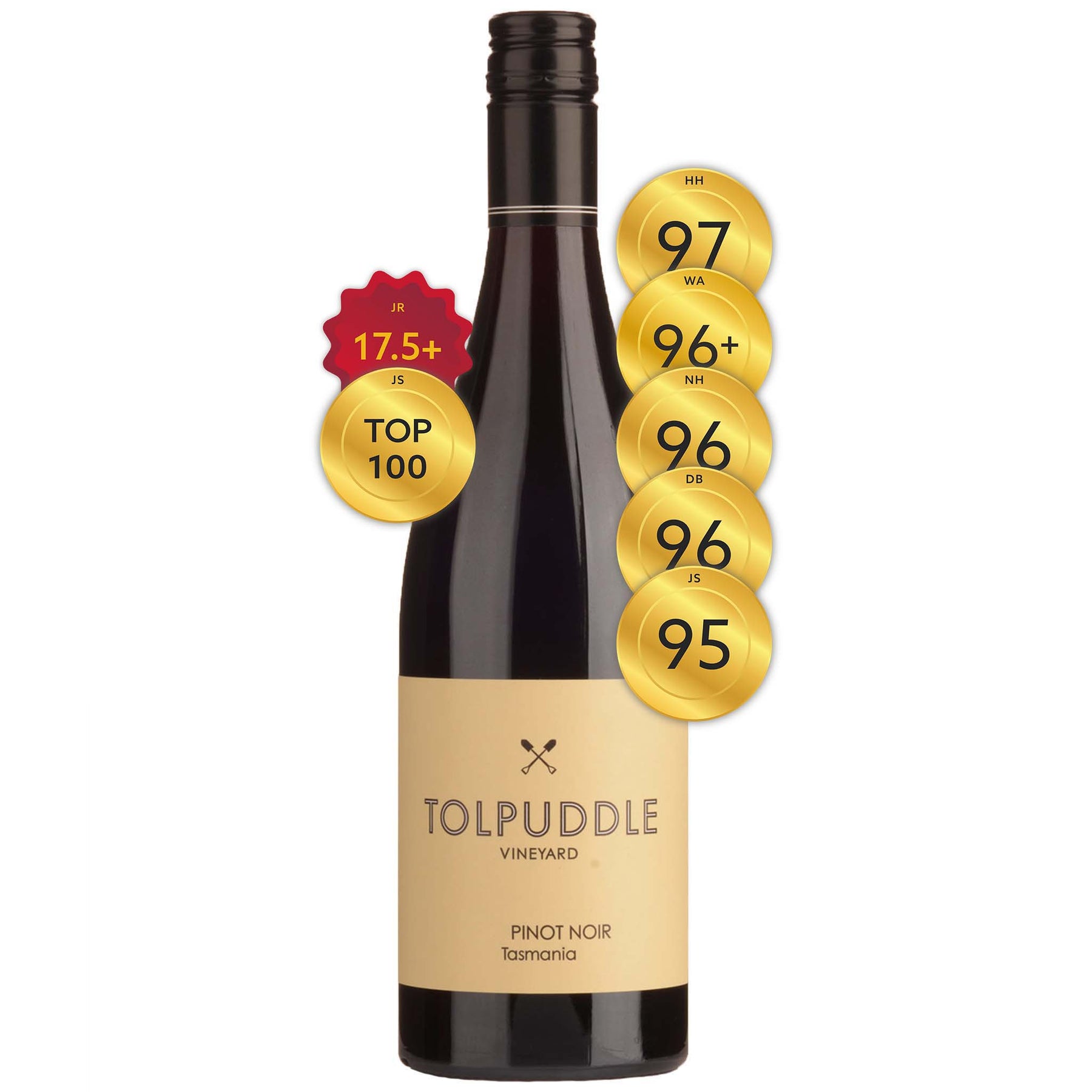
Tolpuddle Vineyard Pinot Noir 2021
Style: Red Wine
Closure: Screwcap
Tolpuddle Vineyard Pinot Noir 2021
Warehouse
34 Redland Drive
Vermont VIC 3133
Australia
Critic Score: 97
Alcohol: 13.5%
Size: 750 ml
Drink by: 2035
James Suckling Top 100 Wines of Australia 2022
Martin Shaw and Michael Hill Smith MW (Shaw & Smith) purchased the vineyard in 2011 after a look-and-see jaunt to Tasmania when they became smitten by Tolpuddle's Coal Valley location and mature vines, planted only to pinot noir and chardonnay. They are fully committed to seeing Tolpuddle Vineyard recognised as one of Australia's great single vineyards.
"This 2021 Pinot Noir is fine, floral, mineral, structured and if possible, a little more structured and perfect than the 2020. It captures a ductile flow of tannin that shapes the fruit, capturing a glistening display of perfectly ripe, restrained fruit. Together, it makes for a polished, scintillating wine. Exceptional." Erin Larkin
In barely a decade, Tolpuddle has established itself as one of the country's top producers. It produces wines of blistering precision and finesse which have received rave critical acclaim. They are highly sought-after and are some of the finest examples of chardonnay and pinot noir that can be found anywhere on the Apple Isle.
"If ever a new winery was born with blue blood in its veins, Tolpuddle would have to be it." James Halliday
"This wine is true to the Tolpuddle Vineyard style. It has very intense red and dark berry fruit, as well as some wild fennel and rhubarb notes on the nose. On the palate, there is a lot of concentrated fruit, balanced by fresh acidity and some fine tannins. Cherry and raspberry notes through to darker blueberry and boysenberry give complexity to a palate that flows seamlessly, and some Chinese five spice characters give a hint of more savoury notes to come with time.
The grapes were all hand-picked and fermented as a combination of whole berries and whole bunches, in open fermenters, with gentle plunging. The wine was aged in French oak for nine months, of which about one third was new." Tolpuddle
Expert reviews
"Excellent depth of red with a strong purple tint, the bouquet black cherry, meaty/charcuterie and mossy undergrowth, while the palate is full and strong, with richness and fleshy extract aplenty, a powerful wine with tannins that are assertive and long. A subtle stalky whole-bunch note on the follow-through. A solidly built pinot of impressive concentration and real substance. Drink 2022-2036." Huon Hooke, The Real Review - 97 points
"Riffing off the same playbook as the excellent 2020 Pinot Noir, this 2021 Pinot Noir is fine, floral, mineral, structured and if possible, a little more structured and perfect than the 2020. It captures a ductile flow of tannin that shapes the fruit, capturing a glistening display of perfectly ripe, restrained fruit. Together, it makes for a polished, scintillating wine. Exceptional. Drink: 2022-2041." Erin Larkin, Wine Advocate - 96+ points
"It's hard to believe that Tolpuddle celebrated its 10th anniversary this year, but I remember being impressed by the wines at the launch, and I still await each release with a similar enthusiastic impatience. This year’s looks good already: perfumed macerated strawberry and raspberry notes with some dark cherry and boysenberry in the bass. There are hints of Chinese five-spice, rhubarb, mushroom broth, sous bois, forest floor and rain falling on turned earth, with perhaps just a whiff of struck flint in the distance. The whole-bunch component here is beautifully judged, the palate shape sleek and possessing ample tension and grace, gentle tannin support weighing in as the wine sails away into the distance. Seamless drinking now but will reward those with patience. Drink by 2035." Dave Brookes, Halliday Wine Companion - 96 points
"A juicy, almost fleshy wine that shows great promise, but the fruit will need time to unwind from the taut acidity and gently grippy tannins. Dense fruit, mainly in the red berry and cherry spectrum, but with a hint of slightly darker berries in the background. Very young, but should be stunning when it settles down." Natasha Hughes MW, Club Oenologique (UK) - 96 points
"I love the transparent, floral nose of this beautifully crafted and extremely fresh Tasmanian pinot noir. Fantastic interplay of mineral acidity with fresh black cherry and ripe strawberry fruit on the super-elegant palate. Long, silky and citrusy finish. From the Coal River Valley sub-region of Tasmania." James Suckling, JamesSuckling.com - 95 points and Top 100 Wines of Australia 2022
"Healthy mid crimson. Complex, layered, approachable nose. Smooth and lively and so much more approachable than young red burgundy. Maybe not as concentrated as 2020. Long." Jancis Robinson MW – 17.5+/20 points
Awards
Top 100 Wines of Australia 2022 - James Suckling
About the winery

Tolpuddle Vineyard was established in 1988by Bill Casimaty, Gary Crittenden and Tony Jordan and it took its name from the Tolpuddle Martyrs: English convicts transported to Tasmania for forming an agricultural union. The leader of the Martyrs, George Loveless, served some of his sentence working on a property near Richmond, part of which is now Tolpuddle Vineyard. The vineyard is planted with mature Chardonnay and Pinot Noir vines, facing north-east, and sloping gently up from Back Tea Tree Road. The soil is light silica over sandstone and of moderate vigour, ensuring well-balanced vines producing grapes of great flavour and intensity.
Martin Shaw and Michael Hill Smith MW (Shaw & Smith) purchased the vineyard in 2011 after a look-and-see jaunt to Tasmania when they became smitten by Tolpuddle's Coal Valley location and mature vines, planted only to pinot noir and chardonnay. They are fully committed to seeing Tolpuddle Vineyard recognised as one of Australia's great single vineyards.
In barely a decade, Tolpuddle has established itself as one of the country's top producers. It produces wines of blistering precision and finesse which have received rave critical acclaim. They are highly sought-after and are some of the finest examples of chardonnay and pinot noir that can be found anywhere on the Apple Isle.
The following text is taken from an article by Jasper Morris that appeared in Inside Burgundy

What began as reconnaissance for Shaw and Hill Smith back in 2011 quickly metamorphosed into profound intrigue thanks in large part to a dinner with industry friends. In this case, it was at the Launceston institution of Stillwater in northern Tasmania with Andrew Pirie – a legend of Tasmanian wine – and veteran winemaker Peter Dawson. The ever-academic Pirie referred to his laptop as he apprised the table of Tasmania’s climatic mapping and data. This was critical information as it informed the pair of just how dry the Coal River Valley was, having made the common assumption that cool equalled wet. The combination of cool and dry added to the allure on account of the long ripening period with slow flavour development and low disease pressure during the growing season. Following some good bottles over dinner, including several from Tasmania, Dawson piqued further interest by declaring that "Tasmania would be making Australia’s best Chardonnay and Pinot Noir within the next decade".
"We’ve got to have this" were the collective words uttered by cousins Martin Shaw and Michael Hill Smith MW upon entry to the Tolpuddle Vineyard site in 2011. The intangible knowing. The feeling in the bones. But what led them down the right path? "We had no intention of buying a vineyard", says Shaw 14 years on as we amble the long, even, north-east facing slope. It’s an idyllic and resplendent blue sky day in the Coal River Valley, around 30 minutes’ drive north east of Hobart. And despite the moderate 25 degree heat, there’s a bite to the bright sunshine on account of the clear skies, low humidity and high UV of southern Tasmania.
Shaw’s casual utterance speaks to the impulsive and serendipitous nature of their Tolpuddle Vineyard purchase, and it’s difficult to fathom how easily it could’ve been missed given the indelible mark it’s made on Tasmanian – indeed Australian – wine. This was during a time when Tasmanian Chardonnay and Pinot Noir was starting to make waves on the Australian wine media circuit, such that it prompted a reconnaissance trip south from the Shaw + Smith stables in the Adelaide Hills where the two had risen to vinous fame.
"The Coal River Valley is cold but dry", continues Shaw, "it’s cooler than Burgundy but warmer than Champagne". The dryness is evident. There’s been little rain in the Valley for months now which is normal given Tasmania’s winter-dominant rainfall. However, this is compounded in the Coal River Valley by a rain shadow effect thanks to the mountains to the west, making it one of the driest regions on the island.
Further visits ensued, including a pivotal one to Accolade-owned Bay of Fires, where then-winemaker Peter Dredge presented barrel samples from vineyards across Tasmania that supplied fruit to Accolade. The wines that excited the pair most came from the Tolpuddle Vineyard which Accolade were using for premium offerings such as Eileen Hardy Chardonnay and House of Arras sparkling wines. The culmination of this was the all-important visit to the site that captured the two so viscerally.
The potential for greatness in a table wine capacity was evident to Shaw and Hill Smith – the forest above, the water below, the long and even Burgundian-like slope in between. What’s more, the valley’s cool climate provided insulation from the looming threats of global warming. With their eyes squarely on the prize, the two set about negotiating acquisition of a site not for sale and – spoiler alert – were quick to succeed. But changes were required to take the site in the desired direction. Certain sparkling-specific clones were replaced with more suitable alternatives, pruning was changed from spur to cane, drainage was improved, frost protection was implemented via a new dam (after having been assured frost wasn’t part of the program!) and mid-row soil was ripped to alleviate compaction. With soils made up of light silica over sandstone, water retention is poor, so composting was implemented upon taking over the site along with undervine clover to keep things cool and assist in holding moisture - critical in this dry terroir. Following further plantings, the vineyard is now 31 hectares with an approximate 50/50 split between Chardonnay and Pinot Noir.
Around the time of the Tolpuddle Vineyard purchase, Shaw and Hill Smith had been trying to entice star winemaker Adam Wadewitz to join the Shaw + Smith team. Wadewitz was winemaker at Best’s Great Western in Victoria at the time, and it was the prospect of working with fruit from the Tolpuddle Vineyard that is said to have sealed the deal. With the inaugural 2012 wines made by Martin Shaw, Wadewitz took over from the 2013 vintage and has excelled with the site ever since.
The Chardonnay is whole bunch pressed, fermented in French barriques and generally sees 100% malolactic fermentation given the bracing southern-Tasmanian acidity. It then spends nine or ten months in barrel with around 30% new. Pinot Noir sees around 30% to 40% whole bunch and around ten months in barriques with 30-35% of it new.
Tasmania
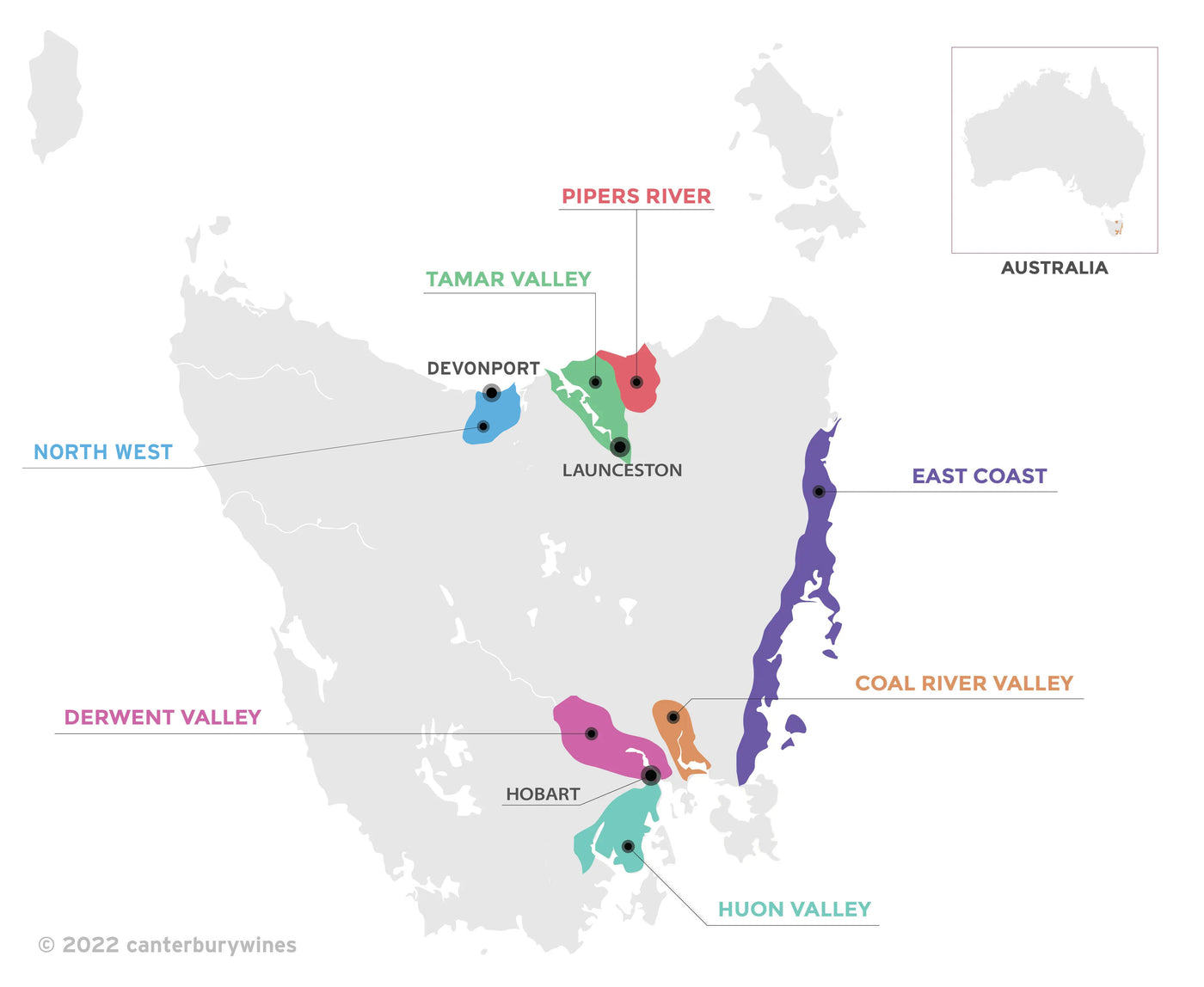
Tasmania is a small island located below mainland Australia. It produces less than 1% of Australia’s wine but enjoys a global reputation as a leading producer of premium cool climate wines. It is prized for its top-class sparkling wine, Pinot Noir, Chardonnay and Riesling.
Tasmania is home to more than 230 wineries across 7 wine regions*. The reigions Coal River Valley, East Coast, Pipers River and Tamar Valley produce around 90% of Tasmania's wine, while the other three regions Derwent Valley, Huon Valley and North West produce the remaining 10%. * Please note these 7 wine areas are considered here to be subregions of Tasmania to aid site navigation.
Tasmania is the coldest wine State in Australia. Its climate is temperate, with a distinct maritime influence from the Tasman Sea to the east, Bass Strait to the north and the Indian Ocean to the west. Summer days are temperate while winter sees some of the coldest temperatures in Australia. It's unique climate and soils combine to create ideal growing conditions for cool-climate grape varieties.