


Yarra Yering Dry Red No 1 2024
Style: Red Wine
Closure: Screwcap
Yarra Yering Dry Red No 1 2024
Warehouse
34 Redland Drive
Vermont VIC 3133
Australia
Critic Score: 98
Alcohol: 13.5%
Size: 750 ml
Drink by: 2045
"I collect this wine each vintage. I believe it's one of the great Cabernet blends in Australia." Erin Larkin
Yarra Yering is one of the oldest and most beautiful vineyards in the Yarra Valley, consisting of 28 acres of vines located at the foot of the Warramate Hills. Dr Bailey Carrodus established the winery in 1969 and is credited as one of the driving forces in reviving winemaking in the Yarra Valley. His first wines, produced from the 1973 vintage, were the first wines to be commercially produced in the Valley for more than fifty years.
"A pure and focused bouquet of pure cassis, gravel and subtle cedar. Equally impressive on the concentrated yet elegant palate. The fine-grained, persistent tannins are in perfect harmony with the fruit. Seamless. A great Dry Red No. 1 in very fine form; a wine that will age effortlessly over the next decade, if not two." Philip Rich
The seductive Yarra Yering Dry Red No 1 is a classic Bordeaux blend of primarily Cabernet Sauvignon, together with smaller parcels of Merlot, Malbec and Petit Verdot. The Cabernet and Malbec and some of the Merlot come from the first plantings into Block No 1 by Dr Bailey Carrodus in 1969 – hence the name. The balance of the Merlot and the Petit Verdot are grown from subsequent plantings made in 1990 on newly acquired neighbouring land.
"Yarra Yering is an extraordinary wine property. Without any fanfare, its winemaker Sarah Crowe puts out a bevy of fabulous wines year after year. Yarra Yering wines have always been very good, but under the current management, they have hit new heights." Huon Hooke
"Blue and black berry fruits with a comforting, rustic iodine feel, complemented by some bay leaf lift. Warming clove spice, a hint of graphite and background oak char bring both flavour and tannin. Glossy, plump fruit, energy and fine tannins form a solid foundation for a long future. Complex and layered, never intimidating but exciting to watch evolve, this vintage is particularly complete on release.
Hand-harvested and sorted, only the best berries make the cut. Cabernet is crushed for structure, while Merlot, Malbec, and Petit Verdot undergo whole berry fermentation for fragrance and weight. Mostly fermented in half-tonne fermenters, hand plunged twice daily. One third of the Cabernet ferments in 3,500L oak cask, with up to 8 weeks on skins for complexity, the balance matured 15 months in French oak barriques, 35% new." Yarra Yering
Expert reviews
98 points - Philip Rich, Halliday Wine Companion
"A blend of 70/16/11/3% cabernet sauvignon/merlot/malbec/petit verdot, the cabernet coming from the original '69-planted vineyard. Matured in barrique (35% new). A pure and focused bouquet of pure cassis, gravel and subtle cedar. Equally impressive on the concentrated yet elegant palate. The fine-grained, persistent tannins are in perfect harmony with the fruit. Seamless. A great Dry Red No. 1 in very fine form; a wine that will age effortlessly over the next decade, if not two. Drink by 2036."
98 points - Stuart Knox, The Real Review
"Deep ruby-red colour with a bright purple tinted rim. Cassis, dried rosemary, crushed granite and cigar box aromatics. A medium bodied delight, the integration of layers is outstanding and takes time to unravel. Black fruit forms the centre stage, with tobacco leaf, cedar wood, dried rosemary and black olive notes ebbing and flowing. It rolls incredibly long, leaving a fine whisper of saline minerality. Enjoyable now, with much more to come. Drink 2026–2046."
97 points - Andrew Caillard MW, The Vintage Journal
"Medium deep crimson. Intense cassis, roasted almond bush, garrigue aromas with some briary complexity. Generous and inky deep with ample blackcurrant pastille, dark plum fruits, some roasted chestnut, grilled almond notes, loose knit grainy tannins and fresh long acidity. Builds up firm and crunchy with attractive pure cassis fruits. This is Yarra Yering at its near-best showing pure varietal definition, character and memory of place. This will evolve into something special. Drink 2028 – 2040+."
96 points - Campbell Mattinson, The Wine Front
"This is a beautiful release. It’s classically styled, classically structured and classically long. It tastes of bay and blackcurrant, cedar and olives, plums and assorted dried leaves. It’s autumnal, sweet with fruit, fresh, mouthwatering and satisfying at once. The length of the finish here, pulsed with dusty tannin, is a magic to behold in itself. This is one of those 'beauty lives here' wines. Drink: 2030-2039+."
96 points - Ryan Montgomery, Jamessuckling.com
"Depth and purity with finesse and complexity. Aromas of blackcurrants, bay leaves, red brick, eucalyptus, violets and graphite. The palate is full yet focused, with earthy austerity cutting through the fresh dark fruit and spices. Lovely old-vine character in a blend of 70% cabernet sauvignon with touches of merlot, malbec and petit verdot from the original 1969 planting. Drink or hold. Screw cap."
95 points - Erin Larkin, The Wine Advocate
"The 2024 Dry Red No 1 is herbal, leafy and succulent. It leads with resinous pipe tobacco, peat, raspberry seed, violet, blood orange notes and licorice. The palate is vibrant, alive and so delicate, however, the "just ripe" aspect of the fruit can sometimes feel a little too al denté - as it does here. It's all a matter of preference, of course - this is a widely admired and respected wine, for good reason. The great Australian wines of old were famously lower in alcohol - many things contributed to this - and as older wines now, their green aspects are one of the elements that help them taste so fresh and charming. I do wonder at that and whether the things I find challenging now will, in fact, be great assets in time. We shall see, as they say. In the meantime, this is a beautiful wine. 13.5% alcohol, sealed under screw cap. Drink: 2026-2044."
Awards
Gold Medal - Yarra Valley Wine Show 2026
About the winemaker

Sarah Crowe was appointed Winemaker at Yarra Yering in 2013 and has never looked back since. She was named James Halliday Winemaker of the Year in 2017, Gourmet Traveller Wine Winemaker of the Year in 2021 and the Australian Society of Viticulture and Oenology (ASVO) Winemaker of the Year in 2021.
Sarah was the first female to win the prestigious James Halliday Winemaker of the Year award. Halliday said, "She has done a fabulous job with what was her first full vintage. Just an amazing, amazing job. She has made red wines of the highest imaginable quality and to the delight of many, myself included, has offered all the wines with screwcaps.”
Meanwhile, on Crowe's watch, Yarra Yering was named Winery of the Year in 2021 by Huon Hooke's The Real Review, and named Winery of the Year and awarded Wine of the Year in 2022 by James Halliday's Wine Companion.
Sarah had no ambitions to be a winemaker. However, on a trip to Europe in her early 20s, Sarah was struck by the beauty of a French vineyard and she remembers thinking to herself "I'm going to work in a vineyard when I get back to Australia.” Several years later, in 2001, she got a job in the vineyard at Brokenwood in the Hunter Valley pruning vines. Sarah stayed on for nine years, completed a viticulture degree and worked her way up to assistant winemaker. In 2009 she won the Hunter Valley Wine Industry Association's 'Rising Star of the Year' Award.
During her time at Brokenwood Sarah also gained valuable experience overseas. She worked international harvests in Oregon in 2004 and 2006 at Adelsheim Vineyard and Ponzi Family Vineyards (focusing on Pinot noir and Chardonnay), and the Rhone Valley in 2008 at Paul Jaboulet Aine (working with Viognier and Shiraz).
She moved to Bimbadgen in 2010 as senior winemaker and brought a new level of sophistication to the wines. She worked with many varieties from across Australia's premium grape growing regions in a range of wine styles. She also took part in the Future Leaders of the Wine Industry Program as well as being accepted as one of only twelve people into the prestigious Len Evans Tutorial Program.
After 12 years in the Hunter Valley, she was offered the coveted job as winemaker at Yarra Yering, established in 1969 by Dr Bailey Carrodus, and headed south to the Yarra Valley.
"Dr Carrodus was a botanist, so the vineyard has always been the central focus of Yarra Yering,” says Sarah. "We've always had more staff in the vineyard than anywhere else.” That focus aligns with Sarah's passion and origins in viticulture. Since joining the team, she's worked with viticulturist Andrew George to revitalise the picturesque vineyard and has evolved the wine styles, all while honouring Yarra Yering's past.
Sarah's approach is all about capturing the unique characteristics of the vineyard and climate, letting the winemaking take a backseat. "My motivation is to make the best wine each year that represents that season,” says Sarah. "Each year is different. And so capturing that in a bottle is what I enjoy the most. Every year we're trying to understand and express the vineyard more, and that comes from a lot of thinking and attention to detail. The best wines do not come easily, but they should look effortless.”
Sarah credits Dr Carrodus for providing her with all the riches a winemaker craves to produce really great wine. "I simply want to make wines which are true to the integrity of the fruit I have to work with. And the fruit is exceptional. With the advances in the scientific understanding of winemaking we have today, I can only improve on the original vision and legacy created by Dr Carrodus,” said Sarah.
About the winery

Yarra Yering is one of the oldest and most beautiful vineyards in the Yarra Valley of Victoria, consisting of 28 acres of vines located at the foot of the Warramate Hills. Dr Bailey Carrodus established the winery in 1969 and is credited as one of the driving forces in reviving winemaking in the Valley - wine production in the Yarra Valley came to a halt in the 1920s due to the economics of the day, changing tastes and the high price of wool.
Bailey Carrodus was well qualified for the task, having completed a degree in horticulture at Victoria University in Wellington New Zealand in 1952, a second degree in winemaking at Roseworthy Agricultural College in South Australia and a Doctor of Philosophy for research into plant physiology at Queens College, Oxford University.
Inspired by the elegance and sophistication of the wines he encountered at Oxford, Carrodus embarked on a study tour of the best vineyards and wineries of France, Spain, Portugal and Italy. Later he took up a position at Melbourne University and began the search for a special vineyard site on which to produce wine in the style he had grown to love. His search brought him to the lower slopes of the Warramate Hills in the Yarra Valley.
In 1969 Dr Carrodus planted 12 acres of unirrigated vines on a northerly slope of deep grey silty loam, shot through with bands of gravel, and named the vineyard Yarra Yering. The first block he planted (Block No 1) to the Bordeaux varieties Cabernet Sauvignon, Malbec and Merlot, the second block (Block No 2) to the Rhône varieties Shiraz and Marsanne. The first wines, produced from the 1973 vintage, were subsequently labelled Dry Red Wine No 1 (a Bordeaux blend) and Dry Red Wine No 2 (a northern Rhône blend). The Yarra Yering release in 1973 was the first wine to be commercially produced in the Yarra Valley since 1922. Wantirna Estate, Mount Mary and Yeringberg followed suit soon after.
In 1987 Bailey purchased the neighbouring property, a Shiraz vineyard planted in 1973, and spent 18 months extensively reworking the vineyard and bringing it back to full health. The first vintage of the Underhill Shiraz from this vineyard was released in 1989.
In 1990 he purchased a west facing hillside and planted alternate Portuguese varieties to take advantage of the hot afternoon sun. The first vintage of the Dry red No 3, a blend of Touriga Naçional, Tinta Cão, Tinta Amarela, Tinta Roriz, Alvarelhão and Sousão, was released in 1996. These grape varieties are most readily associated with Port (a fortified wine) from the Douro Valley in Portugal, but they are also used there to make a dry red table wine.
Dr Bailey Carrodus was a visionary who sought a classical purity in his wines. He also had a reputation as an enigmatic and private man who had a famously gruff manner and found fools insufferable. He was a singularly determined and stubborn individual who had no time for winemaking trends, consumer fads, the influential wine show system, the admonitions of fellow winemakers or the views of wine writers. He famously tipped out thousands of litres of Pinot Noir in one vintage and in another he recalled his entire red wine production, offering a full refund.
Carrodus crafted award-winning wines at Yarra Yering for 35 years until his death in 2008 at the age of 78. From very early on he gained an international reputation for producing elegant, complex, powerful and long-lasting wines. On his death, a number of international publications including Decanter Magazine (UK), The Times (UK), Jancis Robinson (UK) and Wine Spectator (US) published articles acknowledging his immense contribution to the wine industry.
In 2009 Yarra Yering was sold to agribusiness entrepreneur, Ed Peter and established winemaker Reid Bosward, who are also owners of Kaesler Wines in the Barossa Valley. As James Halliday noted: "It was Bailey Carrodus's clear wish and expectation that any purchaser would continue to manage the vineyard and winery, and hence the wine style, in much the same way as he had done for the previous 40 years.” The new owners, who would be hands-off, made it very clear there would be no changes to the philosophy of the business.
It was Reid Bosward who decided to advertise the winemaker job when it fell vacant at Yarra Yering in mid-2013. Sarah Crowe, who had 12 years of experience working in the Hunter Valley, was appointed Chief Winemaker. Despite the pressure created by the legacy Carrodus left, Sarah Crowe has proved more than up to the task and under Crowe's stewardship, the Yarra Yering reputation has soared.
Crowe was named James Halliday Winemaker of the Year in 2017, Gourmet Traveller Wine Winemaker of the Year in 2021 and the Australian Society of Viticulture and Oenology (ASVO) Winemaker of the Year in 2021.
Sarah was the first female to be awarded James Halliday Winemaker of the Year. Halliday said, "She has done a fabulous job with what was her first full vintage. Just an amazing, amazing job. She has made red wines of the highest imaginable quality and to the delight of many, myself included, has offered all the wines with screwcaps.”
On Crowe's watch, Yarra Yering was named Winery of the Year in 2021 by Huon Hooke's The Real Review, and named Winery of the Year and awarded Wine of the Year in 2022 by James Halliday's Wine Companion.
"Yarra Yering is an extraordinary wine property. Without any fanfare, its winemaker Sarah Crowe puts out a bevy of fabulous wines year after year. Yarra Yering wines have always been very good, but under the current management, they have hit new heights. Sarah Crowe is an outstanding winemaker." Huon Hooke
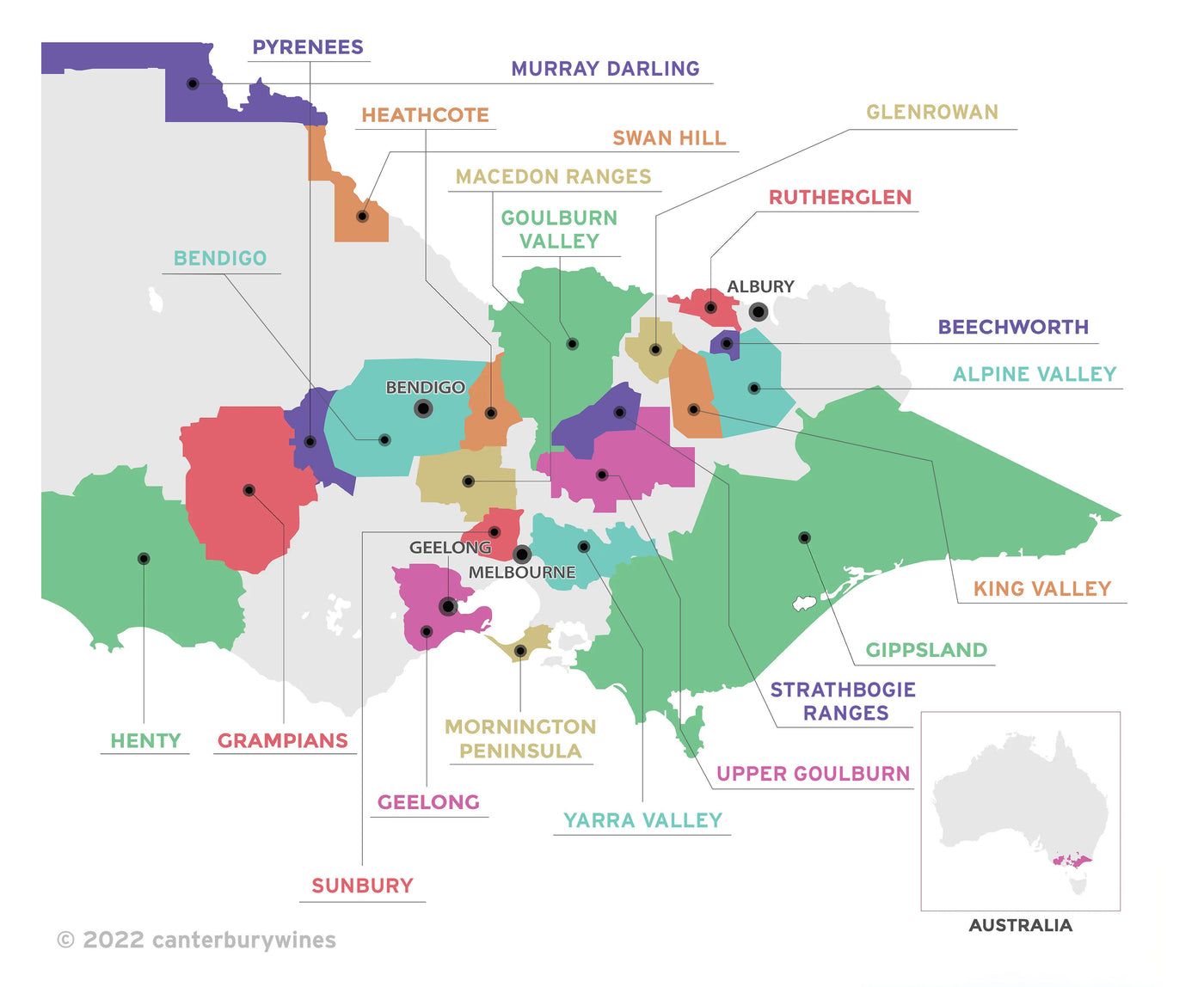
Victoria
Victoria is home to more than 800 wineries across 21 wine regions. The regions are Alpine Valley, Beechworth, Bendigo, Geelong, Gippsland, Glenrowan, Goulburn Valley, Grampians, Heathcote, Henty, King Valley, Macedon Ranges, Mornington Peninsula, Murray Darling, Pyrenees, Rutherglen, Strathbogie Ranges, Sunbury, Swan Hill, Upper Goulburn and Yarra Valley.
Victoria's first vines were planted at Yering in the Yarra Valley in 1838. By 1868 over 3,000 acres had been planted in Victoria, establishing Victoria as the premier wine State of the day. Today, the original vineyards planted at Best's Wines are among the oldest and rarest pre-phylloxera plantings in the world.
Victoria's climate varies from hot and dry in the north to cool in the south and each wine region specialises in different varietals. For example, Rutherglen in the north is famous for its opulent Muscats and Topaque and bold reds, while the many cooler climate regions near Melbourne produce world class Chardonnay and pinot Noir. Victoria is truly a wine lover's playground.